Event 1
Spackle War
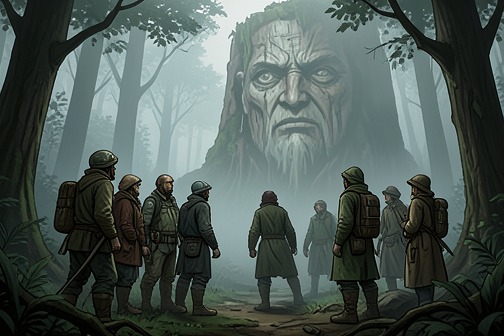
The [Spackle War](entity:event-recall-event-spackle-war-8bca5a1a44f3) is the conflict that turned the settlers’ difficult beginning on [New World](entity:location-recall-location-new-world-7c8068dcbb7d) into a campaign that destroyed most of the [Spackle](entity:character-recall-character-spackle-11fadbeae3d5) community and reshaped human life. [Todd Hewitt](entity:character-recall-character-todd-hewitt-137d446caea3) first learns a confident, simplified account: the Spackle opposed the settlers, used germs as weapons, and were defeated after the [Noise germ](entity:concept-recall-concept-noise-germ-0b0f8cbc89b9) killed women and many men. [Ben](entity:character-recall-character-ben-964df7d0a5ee) later corrects a crucial part of that history. The [Noise](entity:state-recall-state-noise-4da2ff4fcf18) was not a Spackle weapon at all, but a natural phenomenon of the planet; human hardship and a movement that blamed the Spackle helped make war possible. The change in account shifts the conflict from a tale of human self-defense to a history of fear, prejudice, and unequal force.
## The Settlers’ Account
When [Viola](entity:character-recall-character-viola-01912bd40399) asks why animals speak and why she hears thoughts beyond spoken words, Todd explains the history he has been taught. Settlers arrived about twenty years earlier to found New World, where they encountered the Spackle, who, according to the accepted story, did not want them there. The settlers tried to make peace for years, Todd says, but eventually war began. This is presented as inherited knowledge, familiar to the boys of [Prentisstown](entity:location-recall-location-prentisstown-5c48443019b4) rather than as a history Todd has investigated for himself.
In that version, the Spackle fought with diseases. One germ was believed to have been intended to kill livestock but instead made animals able to talk. Another was said to be the Noise germ. Todd’s account associates it with the deaths of half the men and all the women, including his mother, and with the exposure of surviving men’s thoughts. When Viola asks whether any aliens remain, Todd answers that there are none. The certainty of that answer reflects the official story he has received; Ben’s later account will make its absolute conclusion less secure.
## Ben’s Correction
Years later, Ben explains that the Noise germ was not Spackle warfare. The phenomenon already existed in the air when the settlers arrived, and within a day people could hear one another’s thoughts. Viola identifies the qualification that Todd’s earlier account had obscured: it was not everyone. Her silence makes the difference audible in the scene, while Ben’s explanation revises the settlers’ understanding of what the planet is. He describes New World as a place where living things communicate continually. The Spackle had evolved within that condition; the human settlers had not. For them, an excess of information became Noise.
This correction matters because the familiar account had treated a planetary condition as an enemy attack. It also changes the meaning of the settlers’ encounter with the Spackle. The Spackle understood a world of ceaseless information, while the newcomers experienced it as an assault they could not control. Ben does not present the resulting human fear as proof that the Spackle had attacked them. Instead, he separates the existence of Noise from the later political account that made the Spackle responsible for human suffering.
## From Hardship to War
Ben places the war within years of worsening conditions across New World. Crops failed, sickness persisted, and prosperity remained out of reach. In that setting, preaching spread that blamed the Spackle. What began as blame became a movement, and the movement became war. Ben’s sequence gives the conflict a human political cause: hardship did not simply produce violence on its own; it was given a target by a growing campaign against the aliens.
The forces were not equal. Humans had guns, Ben says, while the Spackle did not, and the result was the end of the Spackle as a people in the places humans controlled. Todd interrupts the apparent finality of that conclusion: not all of them were gone. Ben confirms that some survived, but had learned not to come near humans. His qualification recasts Todd’s earlier assertion that there were no aliens left. The war’s outcome was devastating without being an absolute extinction, and its survivors remained separated from the human communities that had fought them.
## Death, Burial, and the War’s Aftermath
The consequences of the war persist in the landscape Todd knows. Spackle dead were put into the swamp, where water and muck could receive them without poisoning the surrounding ground. Ben’s explanation, as Todd understands it, contrasts this practice with human burial and presents the swamp as able to absorb ordinary numbers of bodies. The war overwhelmed that capacity: so many Spackle died that their remains accumulated in heaps, and the swamp took a long time to become swamp again. This history is not a distant abstraction for Todd; he was born into the aftermath, amid an overcrowded swamp and cemetery.
The war’s human casualties and the swamp’s history are often compressed into the same account of germs, madness, and death. Ben’s correction requires those claims to be distinguished. Todd had been taught that the Noise germ killed half the men and every woman, and that the war ended the Spackle. Ben establishes that Noise itself was already part of New World, while separately explaining how anti-Spackle preaching became a war and how armed humans defeated the Spackle. The available account therefore revises the cause of the conflict without making every remembered claim about the deaths disappear.
The war also precedes, but is distinct from, the violence in Prentisstown that Todd learns about from Ben. After the Spackle had been killed, many men of Prentisstown turned against the women and against men who tried to protect them, under the influence of [Mayor Prentiss](entity:character-recall-character-mayor-prentiss-626bb6394987) and Aaron’s preaching. [Jessica Elizabeth](entity:character-recall-character-jessica-elizabeth-3f4ccaa33110), the town’s mayor, foresaw the danger and organized girls and younger boys to flee across the swamp; Mayor Prentiss’s men attacked before she could leave with the women and their defenders. This later account does not make the Prentisstown killings part of the Spackle War. It shows instead how the war’s history of blame and violence sits beside another concealed history that Todd had also been taught incorrectly.
## Historical Significance
The Spackle War is narrated through competing levels of knowledge rather than as a fully witnessed battle. Todd first repeats the version that every Prentisstown boy is expected to know; Ben’s account, given in the presence of Viola, opens that version to correction. The shift is especially consequential because the familiar story treats human victory as a completed defense against a vanished enemy, whereas Ben describes a movement of blame, a military imbalance, surviving Spackle, and a continuing distance between the survivors and human beings.
The event’s legacy is carried in both place and memory. The swamp preserves the scale of the deaths in a landscape that took years to recover, while Todd’s inherited account preserves the assumptions that made the war intelligible to his town. Ben’s testimony does not restore a complete record of every cause or casualty, but it exposes the certainty with which human responsibility had been obscured. The war’s decisive consequence is therefore not only the defeat of the Spackle: it is the creation of a history in which the victors’ explanation must itself be questioned.
Event 2
Noise Germ Outbreak
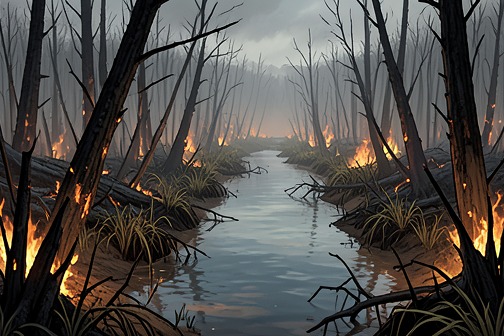
The [Noise Germ Outbreak](entity:event-recall-event-noise-germ-outbreak-945de07a8cf3) is the catastrophe that makes private thought audible across [New World](entity:location-recall-location-new-world-7c8068dcbb7d) and devastates its human population. As [Todd Hewitt](entity:character-recall-character-todd-hewitt-137d446caea3) recounts the history, the disease attributed to the [Spackle](entity:character-recall-character-spackle-11fadbeae3d5) kills every woman, including his mother, and half the men; those who survive can no longer keep their thoughts secret. Its consequences extend beyond individual loss: it helps leave [Prentisstown](entity:location-recall-location-prentisstown-5c48443019b4) isolated, changes what everyday life sounds like, and gives later communities reason to manage sound as a condition of privacy.
## Causes and Background
The outbreak belongs to the war between the settlers and the Spackle. Todd explains to [Viola](entity:character-recall-character-viola-01912bd40399) that settlers came to establish New World, encountered the Spackle, and failed to make peace before conflict began. In the account he has learned in Prentisstown, the Spackle used germs and diseases as weapons. The outbreak is therefore remembered not as a single illness detached from history, but as part of a wider biological conflict whose effects outlasted the fighting.
Todd’s explanation distinguishes the [Noise](entity:state-recall-state-noise-4da2ff4fcf18) Germ from another germ associated with the war. The other disease was thought to have been intended to kill livestock, but instead made animals able to talk; [Manchee](entity:character-recall-character-manchee-553c4e158d6f)’s speech is one everyday reminder of that separate consequence. The Noise Germ, by contrast, killed people and altered the thoughts of the men who lived. Keeping the two effects distinct matters: the talking animals and the exposure of human thought are separate legacies of the settlers’ account of the Spackle’s weapons.
## Death and the Changed Soundscape
The human toll is severe and gendered: every woman dies, while half the men survive. Todd names his mother among the dead. Elsewhere, he describes how the population left in Prentisstown has continued to diminish, with some men dying by suicide and others disappearing. He does not identify each later death as a direct consequence of the disease, but the town’s shrinking, all-male population gives lasting form to the catastrophe’s aftermath.
For the surviving men, the disease also removes the ordinary boundary between inner thought and outward sound. Todd describes the town’s remaining men as a flood of Noise descending on him: thoughts come continually, mixed with words, images, memories, fantasies, secrets, plans, and lies. Noise does not make every thought straightforwardly legible; people can conceal things beneath other thoughts or deceive themselves. Yet it makes privacy precarious, because another person’s mental life can press into shared experience without being spoken aloud.
## Memory, Explanation, and Uncertainty
The outbreak reaches the reader through accounts shaped by what Todd has been taught. When Viola asks why animals talk and why she hears overlapping voices and sees images, Todd gives her the accepted history of the settlers’ arrival, the conflict, and the germs. He presents the killing of women and half the men, and the exposure of the survivors’ thoughts, as what the boys of Prentisstown know. His account establishes the community’s understanding of the catastrophe; it does not provide an independent account from the Spackle or a separate explanation of how the disease works.
That inherited history is also bound to personal loss. Todd explains the germ alongside the death of his mother and the circumstances in which [Ben](entity:character-recall-character-ben-964df7d0a5ee) and [Cillian Boyd](entity:character-recall-character-cillian-boyd-be5e93d6be4c) took him in as a baby and raised him. The outbreak is thus not distant background for him: it defines the family he lost and the care that kept him alive. At the same time, his description of a Noise-free hole—distinct from the merely quieter sounds of the swamp—shows how extraordinary the absence of Noise seems in a world he understands as saturated by it.
## Social Responses and Significance
Noise becomes a problem communities try to manage, though not erase. In [Farbranch](entity:location-recall-location-farbranch-faee876917dd), music plays throughout the settlement to keep men’s thoughts private. [Doctor Snow](entity:character-recall-character-doctor-snow-0553c58bef71) explains that purpose to Viola, who tells Todd; Todd compares the music to the pub in Prentisstown, where music was played to drown out Noise. The different places share a practical response to the same altered soundscape: continuous sound can mask the thoughts that the germ has made difficult to keep private. The music does not undo the disease; it changes the conditions under which people hear one another.
Other sounds clarify the distinction between masking Noise and escaping it. Behind the waterfall, the roar is so powerful that Noise is obliterated, and Todd experiences the result as quiet. The waterfall does not reverse the outbreak or create lasting silence; it briefly overwhelms the channel through which thoughts are perceived. Against that forceful sound, the imagined Noise-free void is a different kind of absence. Together these contrasts make the outbreak’s central consequence more than a medical fact: it has changed how privacy, silence, and shared space can be experienced and controlled.
The event’s historical weight lies in this double rupture. It removes half the men and all the women, including the mothers of the generation that grows up afterward, while making the survivors’ minds part of the surrounding soundscape. In Todd’s telling, war’s biological violence continues as a daily social condition: loss persists in households and population decline, while Noise shapes how people speak, conceal, listen, and seek relief.
Event 3
Viola's Ship Crash
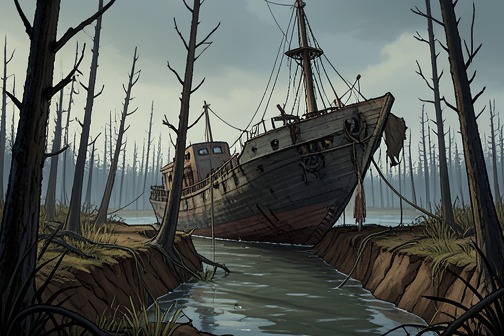
[Viola's Ship Crash](entity:event-recall-event-a4255d6a3508) comes into view as a trail of fresh destruction in the swamp, then becomes a revelation about [Viola](entity:character-recall-character-viola-01912bd40399)'s origins and the deaths of the two people [Todd Hewitt](entity:character-recall-character-todd-hewitt-137d446caea3) understands to be her parents. The scene moves from damaged landscape to ruined ship to bodies: each discovery narrows the possibilities until Todd recognizes that Viola survived a catastrophe alone, only to be found by Aaron.
## The trail through the swamp
Todd catches up with Viola and sees that a tree has been freshly burned and knocked over. The pale, clean splinters of unburned wood show against the damage. More trees have fallen in a line on either side of a great ditch gouged through the swamp. Water has filled it, but piled earth and burned plants mark it as newly made, as if something passed through and tore a channel in a single fiery sweep. Todd turns his torch along the ditch and asks what happened; Viola looks toward the darkness where it disappears. He cannot see what lies there, though he senses that something is present.
The destruction is not merely a background to the discovery. Its straight course gives Todd a clue. He repeatedly shifts the torch between the ditch, the metal ahead, and the scorched ground, beginning to connect them before he knows what the metal is. The landscape records the event indirectly: fallen trees, fire damage, and displaced soil stand in for a crash that neither survivor describes to him.
## The wrecked ship
Viola stops waiting and heads toward the metal, and Todd follows her around a large burned log that still smokes in a few places. The object is much larger than the biggest fissionbike he knows, yet appears to be only part of something larger. It is crumpled and burned across much of its surface. Todd does not know its original shape, but recognizes it as wreckage, then realizes it is the wreckage of a ship—perhaps an airship, perhaps even a spaceship.
That uncertainty matters: the wreck is identifiable as a vessel, but Todd cannot establish where it came from. He considers whether Viola arrived from somewhere else on the [New World](entity:location-recall-location-new-world-7c8068dcbb7d) or from somewhere altogether different, and does not resolve the question. What the scene does establish is physical and immediate: a ship has been destroyed in the swamp, and the long ditch and burned trees belong to the same devastation.
As Todd runs around the wreckage toward a less smashed section, he sees a door opened out from a metal wall and a light still on inside. The surviving light contrasts with the blackened, collapsed exterior; the ship is ruined, but traces of its interior remain. Nearby, [Manchee](entity:character-recall-character-manchee-553c4e158d6f) barks and directs Todd's torch toward Viola, who is standing beside what first looks like two long piles of clothes.
## The dead and the survivor
The piles are two bodies. One is a man, burned almost completely away from the chest down. Burns mark his face, but leave him recognizable as a man; a wound on his forehead would have been fatal even without the burns. Beside him lies a woman. Todd sees no comparable external sign of injury on her—not even blood on her clothes—and can only suppose that she may be injured internally. Both are dead, but the different visible evidence makes their deaths legible in different ways: the man's body bears unmistakable destruction, while the woman's condition remains partly hidden.
For Todd, the woman's presence changes the meaning of what he sees. She is the first woman he has ever seen in the flesh, and he compares her appearance to Viola's, recognizing a resemblance without knowing her identity at first. He asks Viola whether the dead man and woman are her mother and father. Viola says nothing, so the identification remains Todd's inference rather than a spoken confirmation. Still, the bodies, the resemblance, and the wreckage lead him to a clear account: Viola crashed there with her parents; they died, and she lived.
Drag marks on the ground show that Viola must have pulled the bodies away from the crash and brought them to where they lie. Todd notes that the swamp is unsuitable for ordinary burial: after a shallow layer of dirt, there is mostly water. The bodies therefore remain above ground, and the swamp's general smell makes it difficult for Todd to tell how long they have been there. The marks record an act of care, while the terrain explains why that care could not become burial.
## Consequences and significance
Todd's conclusion extends beyond the crash itself. Viola was alone in the swamp after her parents died, and Aaron found her there. The discovery makes Aaron's connection to her part of the aftermath of the wreck, though the evidence does not explain how or when he encountered her. The crash thus supplies the immediate history behind Viola's isolation, without answering where her ship came from or filling in the time between her survival and Aaron's arrival.
The scene also turns a silent encounter into testimony. Viola offers no verbal account; Todd reconstructs events from the ditch, the wreckage, the bodies, and the drag marks. His narration moves from uncertainty about what the metal is to certainty about the deaths and Viola's survival, while leaving her origins unresolved. The wreck is both an actual disaster and the material evidence through which Todd first understands the loss behind Viola's presence in the swamp.
Event 4
Todd's Escape from Prentisstown
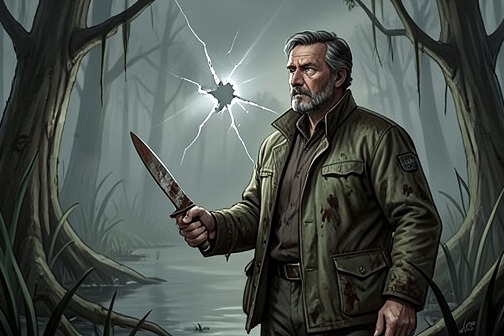
Todd’s escape from [Prentisstown](entity:location-recall-location-prentisstown-5c48443019b4) begins with a discovery that neither he nor [Manchee](entity:character-recall-character-manchee-553c4e158d6f) can explain: a tear in the [Noise](entity:state-recall-state-noise-4da2ff4fcf18) in the [Swamp](entity:location-recall-location-swamp-a8f3ec59b425). [Ben](entity:character-recall-character-ben-964df7d0a5ee)’s reaction turns that strange absence into an urgent threat. When the town’s authorities arrive looking for Todd, [Cillian](entity:character-recall-character-cillian-746514cf96d5) and Ben divide the work of protecting him, and Todd is sent away by the river with Manchee and Ben’s knife. The escape is also a forced farewell to the two men who raised him: their effort to secure his freedom requires them to remain behind in danger.
## The discovery and the decision
Todd tries to describe what he and Manchee found as a rip in the Noise, something present but hidden. As he remembers the encounter, he opens his Noise to Ben and tries to communicate the truth of it while keeping his thoughts quiet enough not to draw the town’s attention. That effort exposes how precarious the discovery is: Noise can carry thought beyond the person speaking, so even explaining the danger risks revealing it.
Todd asks whether the hidden presence is [Spackle](entity:character-recall-character-spackle-11fadbeae3d5) and whether another war may follow. Ben does not answer those questions directly. Instead, he reacts with alarm and insists that Todd and Cillian must not think about the discovery openly. His warning makes clear that the danger lies not only in what Todd saw, but in the possibility that other people can hear what he knows. The threat is still uncertain, but Ben treats concealment as an immediate necessity.
Ben and Cillian then tell Todd that he has to leave Prentisstown. Todd objects that there is nowhere else on [New World](entity:location-recall-location-new-world-7c8068dcbb7d) for him to go, revealing how completely the town has defined the limits of his world. The adults do not explain everything at once; their exchanged looks and guarded Noise leave him with the decision before he has a full account of its cause. The escape begins, therefore, as both a practical response to danger and a rupture in Todd’s understanding of where he belongs.
## The threat reaches the farm
The decision becomes urgent when [Mr Prentiss Jr](entity:character-recall-character-mr-prentiss-jr-d2c05f47a7e1) arrives with a rifle. He claims that he and the people with him merely want to speak to Todd, but Cillian challenges the mismatch between that reassurance and the weapon. Mr Prentiss Jr explains that a word has travelled into town through Todd’s Noise and says that [Mayor Prentiss](entity:character-recall-character-mayor-prentiss-626bb6394987) wants to see him. The hidden discovery has already become a matter of official attention, and Todd’s attempt to speak about it has helped expose him.
The encounter turns physical before Todd can be brought out. Ben and Todd hear the disturbance and reach the kitchen to find Mr Prentiss Jr on the floor, while Cillian holds the sheriff’s rifle and orders him off the property. The brief reversal matters: Mr Prentiss Jr had arrived as an armed representative of the town’s authority, but Cillian has taken control of his weapon and driven him back. Even so, the confrontation does not resolve the danger. Mr Prentiss Jr leaves, and Cillian immediately says that Todd must go through the Swamp.
Cillian’s choice to remain behind separates him from Todd at the moment the escape becomes real. He hugs Todd roughly enough that Todd’s cut lip strikes his collar, then tells him that he and Ben are acting out of love, though Todd rejects the decision as not all right. Cillian does not ask Todd to approve. He tells Ben to run and says that he will hold the others off as long as he can; Ben, in turn, plans to take another route to confuse anyone tracking Noise.
## A farewell made practical
Before leaving, Ben explains the route: Todd is to reach the river, follow it down to where it meets the Swamp, and continue out. Todd points out that there is no path that way and that crocodiles are there, so the route offers no sense of safety. Its importance is that it leads away from Prentisstown and avoids a more direct path through the danger now gathering around the farm.
Ben embraces Todd again and tells him that after Todd’s mother died, Todd became their son, and that both Ben and Cillian have always loved him. The declaration gives the departure its emotional meaning: Todd is not being sent away because the bond has failed, but because the men who raised him are trying to preserve his life. He begins to say that he does not want to go, but the sound of a tremendous explosion from the direction of the farm interrupts him.
Ben’s Noise fills with Cillian’s name as he lets Todd go. The explosion makes the separation more than a plan or threat: something is happening at the farm, and Ben has to turn back. Todd later reasons that Cillian may have blown up the generators to confuse the men and overwhelm the town’s Noise. The narration presents this as Todd’s inference, not as something he witnesses directly. What he does know is that the explosion comes from home and that Ben is returning toward it.
## The knife, the promise, and the river
Ben demands a promise that Todd will keep going. Manchee barks in fear as Ben unclasps his hunting knife and gives it to Todd. The knife has a personal significance as well as a practical one: Todd had hoped to receive it for his birthday, when he would become a man. Now Ben gives it to him before that anticipated milestone, and Todd takes it despite admitting that he has never fought a Spackle.
A further explosion sounds from the farm. Ben directs Todd to follow the river down to the Swamp and out, orders him not to turn back, and grips his arm as he promises that he will find Todd if he can. Ben then runs toward the farm, looking back once. Todd’s own impulse is to follow him, but he turns to run with Manchee instead. The difference between what Todd wants and what he does gives the promise its force: continuing away from home is an act of obedience to the people he loves, even when it feels like abandoning them.
Todd and Manchee reach the river and follow it downhill, keeping away from the rushes where the crocodiles live. Todd takes the knife from its sheath and carries it in his hand as they move quickly. The escape thus ends its opening stage not in safety but in flight: Todd has left the farm, the two men who raised him are behind, and the route ahead passes through an exposed landscape where he must rely on the knife, Manchee, and the promise he made.
## Narrative role and significance
The escape shifts Todd from the bounded life he knows in Prentisstown into a journey beyond it. The change is driven by two connected dangers: the discovery in the Noise and the town’s response once the discovery becomes audible. The men’s warnings and divided plans show that staying hidden is no longer enough; Todd must physically leave before the authorities can take him.
The event is also structured around separation. Cillian remains at the farm to delay the threat, while Ben first guides Todd away and then returns when the explosions draw him back. Their departures from Todd are not identical, but both turn protection into an action with personal cost. The knife passes from Ben to Todd as a tangible sign of care and a tool for the dangers ahead; the promise binds Todd to that care even as he is forced to travel without its providers beside him.
Todd’s route out of Prentisstown begins with uncertainty rather than triumph. He does not know exactly what the tear in the Noise means, cannot tell what is happening at the farm, and must accept a dangerous way through the Swamp. Yet the escape establishes a decisive boundary: the town can no longer contain his life, and the attachment that once made it home now sends him away from it.
Event 5
Todd Finds Viola in the Swamp
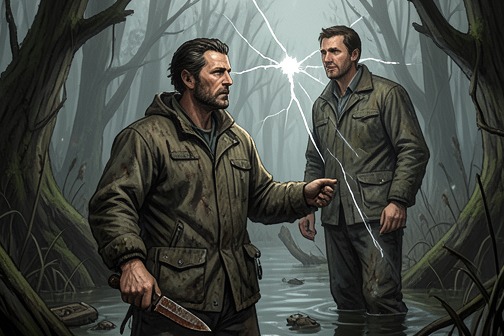
[Todd Finds Viola in the Swamp](entity:event-recall-event-3029bf2f9312) begins with a mystery that overturns [Todd Hewitt](entity:character-recall-character-todd-hewitt-137d446caea3)’s expectations: a gap in the [Noise](entity:state-recall-state-noise-4da2ff4fcf18) leads him to a girl, not a [Spackle](entity:character-recall-character-spackle-11fadbeae3d5). The encounter makes his accustomed way of reading the world unreliable, and turns an armed search for an enemy into a cautious meeting with someone equally alone and wary.
## The [Silence](entity:state-recall-state-silence-e65fd1fb1909) in the [Swamp](entity:location-recall-location-swamp-a8f3ec59b425)
Todd first senses a hole in the Noise: not simply a quieter patch of swamp, but an absence he can recognize by the way surrounding sounds seem to meet it. The distinction matters because the swamp itself is never truly quiet. This is something different, a space where Noise appears to stop altogether. Todd cannot see its source, and the strange absence becomes an object of pursuit precisely because he has no ordinary evidence to explain it.
[Manchee](entity:character-recall-character-manchee-553c4e158d6f) reacts to the same phenomenon, barking about quiet and running toward it. Todd follows, but the approach overwhelms him. The silence brings on a grief-like pressure, and he stops long enough for the gap to move away. His distress is not just fear of what may be hidden there: the silence feels like the loss of something valuable, though he does not yet know what that something is. The first pursuit therefore ends in frustration and makes the anomaly more compelling rather than resolving it.
Later, Todd and Manchee run back toward the Spackle buildings. Todd carries a knife and, in his anger and fear, has decided that the hidden Spackle must die for what has happened that day. The plan depends on his treating the unexplained silence as evidence of a familiar enemy. When the tear in the Noise appears behind the buildings and moves through the bushes, Manchee again leads the way. Todd follows without stopping this time, controlling his distress as he runs. At the tree, however, he halts. The expected target is not what he imagined.
## The Expected Enemy and the Girl
Todd’s sudden stop marks the decisive reversal. The silent presence is not a Spackle; it is a girl. He remains frightened and keeps the knife extended, but the discovery breaks the simple logic that had driven his pursuit. The silence he had treated as a sign of danger belongs to a person, and his readiness to kill an unseen enemy now confronts him with someone standing directly before him.
The meeting is not immediately peaceful. While Todd examines a map [Ben](entity:character-recall-character-ben-964df7d0a5ee) left in his book, the girl approaches without his hearing her and strikes him with a stick. Todd swings his knife in response, and both are left hurt and startled. The encounter gives Todd a practical lesson in the danger of a presence that makes no Noise: someone can come close without his usual warning. It also shows that the girl is not merely a passive mystery. She acts to defend herself, and Todd’s weapon and his assumptions make him dangerous to her as well.
Their first attempt at communication remains tentative. Todd tells her he will not hurt her, while making that promise conditional on her not hitting him again. She looks from his eyes to the knife, a small gesture that keeps the threat of the weapon present even as he tries to reassure her. The scene does not offer instant trust or a clear understanding between them. Instead, it lets caution and the possibility of cooperation occupy the same moment.
## The Wreck and the Cost of Being Alone
The crashed ship gives Todd a context for the girl’s presence. Looking over the wreckage, he concludes that she arrived with her parents and that they died while she survived. He cannot tell whether she came from somewhere else on [New World](entity:location-recall-location-new-world-7c8068dcbb7d) or from beyond it, and recognizes that her origin does not change the immediate facts: she is alive, her parents are not, and she has been alone. The wreck turns an apparently impossible silence into part of a concrete human loss without explaining every question surrounding her arrival.
Todd also realizes that Aaron found her. The girl’s slight reaction when Todd mentions Aaron’s name suggests that the name carries meaning for her, though she says nothing to confirm what she knows. Todd apologizes for her parents and later for the situation more generally, even as he admits to himself that he cannot identify exactly what he is apologizing for. His response is awkward, but it marks a change from his earlier certainty that he had found a target to kill: he now sees a bereaved person whose danger is connected to the pursuit around them.
## A Cautious Offer to Leave
Todd tells the girl that they cannot stay because others may come after them, even if Aaron is dead. He thanks her for the food and asks whether she will come with him. The invitation does not erase the hazards between them: he still has the knife, she has already defended herself, and neither has established full trust. But Todd now frames their next step around getting away together rather than attacking the person concealed by the Noise.
The girl answers through action rather than speech. She uses the tip of her boot to knock burning sticks from a small green box, presses its button, and picks it up without burning herself. Todd notices the device and wants one, but its place in the scene is also practical: it belongs to the supplies she has and the food she has shared. The evidence does not make her acceptance of his offer explicit. It leaves the meeting at the threshold of companionship, with Todd asking and the girl continuing to act on her own terms.
The discovery’s significance lies in the gap between what Todd hears and what he thinks he knows. His Noise-guided world encourages him to treat silence as an alarming absence and, in his anger, to fill that absence with an enemy. Finding [Viola](entity:character-recall-character-viola-01912bd40399) exposes the limits of that assumption. Their encounter begins not with easy recognition but with pursuit, a mistaken expectation, a defensive clash, and the first incomplete steps toward mutual reliance.
Event 6
Todd and Aaron Clash in the Swamp
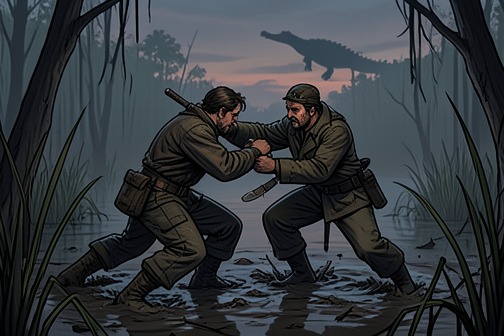
[Todd and Aaron Clash in the Swamp](entity:event-recall-event-1c6ca91c8257) is a linked series of confrontations in which Aaron first attacks Todd, then pursues [Viola](entity:character-recall-character-viola-01912bd40399), and is finally left alive after Todd overcomes him. The struggle brings Todd close to death, but its decisive outcome is not simply Aaron’s defeat: Todd declines to make the knife an instrument of execution and instead leaves the swamp with Viola and [Manchee](entity:character-recall-character-manchee-553c4e158d6f).
## Causes and Background
The clash begins just after Todd and Manchee survive an attack by crocodiles. Their relief makes them noisy, and Aaron is able to approach before they realize he is there. He addresses Todd as a boy who is going somewhere, punches him, and orders him to return because there are things he needs to see. Todd reads the flickers in Aaron’s [Noise](entity:state-recall-state-noise-4da2ff4fcf18) and concludes that the crocodiles had been drawn to him by Aaron, not by Todd’s own Noise. Aaron’s response does not straightforwardly confirm every part of Todd’s accusation, but his remark that smart boys make useless men sharpens the threat behind the encounter: Todd’s intelligence and his approaching adulthood place him in conflict with the world Aaron represents.
Todd does not let go of his knife. As Aaron prepares to strike again, Manchee warns of another crocodile, which attacks Aaron and forces him to release Todd. Todd is bruised and frightened, but he gets up and runs with Manchee, carrying his knife and rucksack. Their escape is only temporary. At the swamp buildings, Todd is already set on finding the [Spackle](entity:character-recall-character-spackle-11fadbeae3d5) he believes is hiding there and killing him for what has happened that day. The event thus begins with Todd’s own appetite for retaliation, even as the next turn will make him confront what killing would mean.
## Aaron Pursues Viola
The danger catches up with Todd and Viola before they can get away. Aaron charges through the trees and attacks Todd, while Todd’s dropped rucksack pins his arm and prevents him from using the knife effectively. Manchee bites Aaron’s leg, giving Todd the chance to breathe again. Aaron throws Manchee aside, but Viola has already escaped. Aaron hears her running and follows her without stopping to deal with Todd.
Todd is briefly left alone, but Viola’s screams draw him after them. He finds Aaron holding her beside shallow water, with her wrists restrained as she struggles to get free. Aaron’s Noise fills Todd’s perception with religious images of Viola as a sacrament, a sign from God, a path to sainthood, and an angel. Those images make plain the role Aaron assigns her: he sees her not simply as a person trying to escape, but as a sacrifice within his religious vision. Todd tells Aaron to leave her alone, but his words cannot compete with the force of Aaron’s Noise.
## The Fight and Its Reversal
Todd confronts Aaron with his knife, but Aaron knocks it from his hand, strikes him down, and pins him in the water. Todd believes he has lost and that he is about to die. He is weaker than he was during their first encounter, and Aaron appears to have the advantage. The reversal comes when Todd reaches for a rock and strikes Aaron repeatedly. Aaron falls still enough for Todd to sit up and breathe; Manchee returns to his side as Todd tries to recover.
Aaron is not dead. Todd sees that he is still breathing and understands that the immediate struggle has left him with a choice rather than a finished outcome. The knife remains in his hand. He thinks through the reasons Aaron deserves to die: Aaron tried to kill him, intended to kill Viola, and is implicated in the violence that has reached [Prentisstown](entity:location-recall-location-prentisstown-5c48443019b4) and cost [Ben](entity:character-recall-character-ben-964df7d0a5ee) and [Cillian](entity:character-recall-character-cillian-746514cf96d5) their place in Todd’s life. Yet Todd cannot bring the knife down. He treats that refusal as a decision with consequences, not as proof that Aaron is harmless or that the danger has disappeared.
## Departure and Wider Significance
Todd tells Viola they have to leave. She follows him and Manchee, and they retrieve Todd’s rucksack before moving farther into the swamp to put distance between themselves and Aaron. The scene ends without confirming Aaron’s death; Todd leaves hoping that the still, breathing figure will not rise again. His choice protects his own moral boundary, but it does not resolve the threat Aaron poses.
Later revelations about [New World](entity:location-recall-location-new-world-7c8068dcbb7d) place Aaron’s conduct within a larger history of scapegoating and violence. Ben explains that hardship and fear were turned into blame against the Spackle, and that preaching became a movement and then a war in which humans had the advantage of guns. Todd later identifies Aaron’s role in preaching that what was hidden must be evil, a doctrine that helped [Mayor Prentiss](entity:character-recall-character-mayor-prentiss-626bb6394987) sway men into killing the women of Prentisstown and those who tried to protect them. The town’s coming-of-age killings likewise made boys participate in executions, leaving the community complicit in the violence that defined its idea of manhood. These disclosures do not change what happens in the swamp, but they clarify why Todd’s refusal matters: he has been given the chance to repeat a system in which killing is treated as necessary, righteous, or formative, and he does not accept it. The encounter therefore joins a rescue and a fight to a larger question about whether survival must reproduce the violence that made the danger.
Event 7
Viola Blows Up the River Bridge
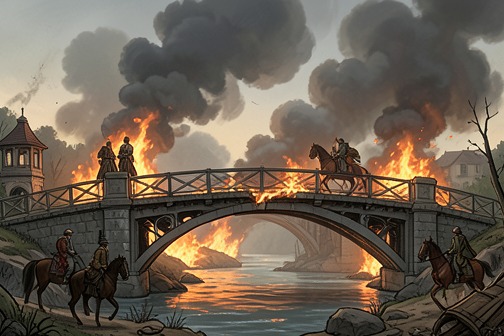
[Viola Blows Up the River Bridge](entity:event-recall-event-33f37967240f) is the turning point in a pursuit: with [Mayor Prentiss](entity:character-recall-character-mayor-prentiss-626bb6394987) and his riders almost upon them, [Viola](entity:character-recall-character-viola-01912bd40399) uses the fluid in her campfire box to destroy the bridge and block their crossing. The act buys time for [Todd Hewitt](entity:character-recall-character-todd-hewitt-137d446caea3) and Viola, but it also makes their resistance public and direct. Across the burning gap, the Mayor answers the ruined crossing with a promise to continue the pursuit.
## The pursuit reaches the bridge
Todd and Viola have crossed the river and are trying to cut the bridge’s ropes when the riders appear behind them. [Todd’s knife](entity:object-recall-object-todd-s-knife-33a8a6c051f3) proves ineffective: the rope is coated in a thin, unusually tough resin, and his attempts make almost no progress. The detail matters practically as well as dramatically. The bridge cannot be dismantled quickly by hand, while the approaching horses are closing the distance at speed.
The riders become visible without binoculars, growing larger as they thunder toward the crossing. At first Todd estimates that they have three or four minutes; soon the interval has dwindled to about a minute. From the opposite side, the pair can make out the men’s faces and hear their [Noise](entity:state-recall-state-noise-4da2ff4fcf18) traveling up the river. Mr MacInerny, the Mayor’s leading horseman, rides in front, with Mayor Prentiss behind him. The Mayor’s calm appearance contrasts with the urgency of the approaching column and the shrinking time available to act.
## Viola turns the campfire box into a weapon
Exhausted, Todd proposes that they run, though he recognizes how little chance they have. Viola instead takes the campfire box from her bag, sets it down beside a large rock, and breaks it open. She twists the damaged box until it leaks fluid, then spreads that fluid over the knots at the nearest bridge stake and empties the remaining drops into a puddle at its base. Her actions are purposeful and quick: she targets the fastening that holds the bridge and prepares the spilled fluid to be ignited.
Todd begins to object, but Viola directs him to get back. He retreats with [Manchee](entity:character-recall-character-manchee-553c4e158d6f), while she steps away from the bridge holding the remains of the box at arm’s length. She presses a button, tosses it toward the puddle, and jumps back beside Todd. The sequence leaves little room for discussion or hesitation. The riders are reaching the crossing as the device falls, and Viola’s decision converts the box from camping equipment into the means of stopping them.
## The crossing collapses
Mr MacInerny’s horse puts a hoof on the bridge just as the box lands in the fluid. The explosion is far larger than the small quantity of liquid suggests. It destroys the ropes and stake, sends burning splinters outward, and momentarily overwhelms thought, Noise, and sound. The bridge catches fire and begins to lean; Mr MacInerny’s horse rears and stumbles as other horses crowd behind it.
The end of the bridge on Todd and Viola’s side gives way, carrying Mr MacInerny and his horse down into the river. The fall is described as unsurvivable. The far end remains attached briefly, striking the facing cliff, but the flames are consuming the structure. Mayor Prentiss, [Mr Prentiss Jr](entity:character-recall-character-mr-prentiss-jr-d2c05f47a7e1), and the other riders have to back their horses away. The bridge has therefore achieved its immediate purpose: it has broken the pursuit’s route across the river, though at the cost of the leading rider and his horse.
## A reprieve, not an end to the pursuit
After the blast, Viola crawls away from Todd, and the two sit dazed, breathing and coughing as they recover enough to look across the canyon. The sudden destruction has changed the immediate balance of the chase, but it has not resolved the conflict. The smoke and burning bridge separate the pursuers from the pair; the Mayor remains on the other side, still able to address Todd across the gap.
Mayor Prentiss calls to Todd through the smoke and says that they are not finished, not by a long way. He remains composed, presenting the collapse as a temporary obstruction rather than a defeat. Todd answers with a two-finger gesture, but the Mayor disappears behind the smoke before the exchange can become anything more. The scene thus ends with both a concrete escape and a renewed threat: Viola has stopped the riders from crossing, while the Mayor makes clear that the pursuit will continue.
The event’s force comes from the reversal between an apparent dead end and a sudden opening. The resin-coated ropes defeat Todd’s knife, the riders reduce the available time to moments, and Viola’s improvised use of the campfire box changes the bridge itself into a barrier. Yet the explosion does not bring safety or reconciliation. It separates the two sides, leaves a fatal consequence at the crossing, and gives the Mayor a final opportunity to assert that the conflict remains unresolved.
Event 8
Todd and Viola Take Shelter with Hildy and Tam
Todd and [Viola](entity:character-recall-character-viola-01912bd40399)’s shelter with [Hildy](entity:character-recall-character-hildy-b5ad992c9fad) and [Tam](entity:character-recall-character-tam-5f2cd5d6e8be) unsettles the rules Todd has taken for granted about [Noise](entity:state-recall-state-noise-4da2ff4fcf18), women, and survival. The meeting offers immediate safety and kindness, but its more lasting consequence is epistemic: Hildy and Tam’s ordinary life contradicts Todd’s belief that Noise kills women, while their measured response to his certainty signals that [Prentisstown](entity:location-recall-location-prentisstown-5c48443019b4)’s past has been distorted or concealed.
## The meeting and its first contradiction
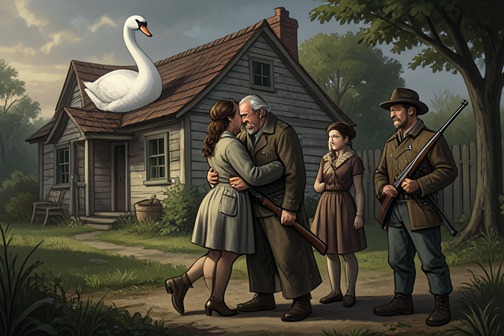
As Hildy and Viola move farther away, an old man approaches with one hand raised in greeting. He carries a rifle, but holds it low and points it at the ground. His Noise rises as he comes toward Hildy, remains raised as he puts an arm around her and kisses her in greeting, and continues as he turns to Viola. Viola hangs back slightly from the warmth of this introduction. The scene presents a threat that does not become an attack: the rifle marks the newcomer as armed, while its lowered position and his affectionate greeting establish a different intention.
Todd recognizes the contradiction before he can make sense of it. Hildy is married to a man whose Noise is audible, and Tam moves openly through the world with Noise. For Todd, whose experience has made Noise seem inseparable from male life and danger, this is not merely a new acquaintance but evidence that the world’s rules may not be what he was taught. He says he wants the world to make sense, and Hildy answers him kindly rather than dismissing his confusion.
## The question of a cure
The possibility of Tam’s existence as a noisy, grown man prompts Todd to ask whether there is a cure. His hope is sudden and powerful: he asks twice, and his voice nearly breaks. Tam answers that, if a cure existed, he would not be subjecting Todd to the thoughts that spill into Noise. The exchange does not offer a remedy; instead, it makes plain that Tam’s difference from Todd is not the result of a cure. Todd’s question therefore shifts from how Tam has escaped Noise to whether the assumptions behind that question are wrong.
The deeper challenge comes when Todd insists that Noise kills women and that every woman in Prentisstown died from it, including his mother. Tam says women are immune. Todd rejects the claim, relying on what he has witnessed and been told at home; he speculates that the version released by the [Spackle](entity:character-recall-character-spackle-11fadbeae3d5) may have been stronger. Tam puts a hand on his shoulder to stop him. The gesture interrupts the argument without resolving it, and the contrast between Todd’s urgent certainty and Tam’s restraint keeps the scene focused on how difficult it is for Todd to revise a belief bound up with his mother’s death.
## A history held back
Hildy and Tam exchange glances when Todd asks how Hildy can be alive. Todd senses that Tam is keeping something back, though what he perceives in Tam’s Noise is kindness. Tam says that Prentisstown has a sad history and that many things went wrong there. Hildy does not explain further in this moment. Instead, she turns attention to immediate care: she rubs Viola’s shoulder, and Viola does not resist, then urges Todd to eat and sleep after his long journey. Shelter is thus both physical hospitality and a pause before the painful explanation Todd is not yet ready to receive.
The withheld history is disclosed later, in [Ben](entity:character-recall-character-ben-964df7d0a5ee)’s account of the [New World](entity:location-recall-location-new-world-7c8068dcbb7d). As conditions worsen—crops fail, sickness spreads, prosperity disappears—preaching begins to blame the Spackle. That blame becomes a movement and then a war. Humans have guns and the Spackle do not, and Ben describes the result as catastrophic, though not every Spackle is killed. His account supplies a wider history of violence behind the fear and misinformation that shape Todd’s understanding of his home.
Ben also confirms the truth behind the deaths of Prentisstown’s women. After the war against the Spackle, many men in Prentisstown, swayed by [Mayor Prentiss](entity:character-recall-character-mayor-prentiss-626bb6394987) and Aaron’s preaching, killed the women and those men who tried to protect them. Todd says that his mother was among the dead, and Ben confirms it. This revelation explains why Todd’s conviction that women die from Noise cannot be corrected by Tam’s simple statement alone: Todd has mistaken a local atrocity for a universal rule.
## The violence behind the town’s rules
Later revelations connect Prentisstown’s concealed history to its coming-of-age killings. Todd learns that his former schoolteacher, Mr Royal, did not shoot himself; Seb Mundy killed him on Seb’s thirteenth birthday as the men of Prentisstown watched. Mr Gault, whom Todd believed had disappeared, had tried to escape through the swamp. Mayor Prentiss captured him and arranged for [Mr Prentiss Jr](entity:character-recall-character-mr-prentiss-jr-d2c05f47a7e1) to torture him to death on his own thirteenth birthday. When the authorities lacked a captured escapee, they could take someone disliked in town and claim he had disappeared instead.
The pattern turns a boy’s passage into manhood into a killing imposed on another person, with the town’s men made witnesses and participants. Todd’s later recognition that everyone was complicit, except himself, gives the earlier shelter scene additional weight: Hildy and Tam’s hesitation was not a refusal to help him, but a sign that the story he carried from Prentisstown was bound to a history of organized violence. The refuge first makes the contradiction visible; the later disclosures show the human cost of the lies that made it seem impossible.
Event 9
Viola Reveals the Approaching Colony Ship
[Viola](entity:character-recall-character-viola-01912bd40399)'s revelation that thousands of settlers are on their way to [New World](entity:location-recall-location-new-world-7c8068dcbb7d) changes the meaning of her arrival: the craft that brought her was only a scout, while the much larger [Expansion Class Seven Colony Ship](entity:object-recall-object-expansion-class-seven-daf264a5243e) remains beyond her reach. With its systems broken and no way to send a warning, Viola cannot stop or redirect the approaching ship. The news gives [Todd Hewitt](entity:character-recall-character-todd-hewitt-137d446caea3) a responsibility he does not yet understand, and places the future of the planet against the troubled history later disclosed to him.
## Discovery at [Hildy and Tam's Swan-Shaped Farmhouse](entity:object-recall-object-hildy-tam-61ab033e83fc)
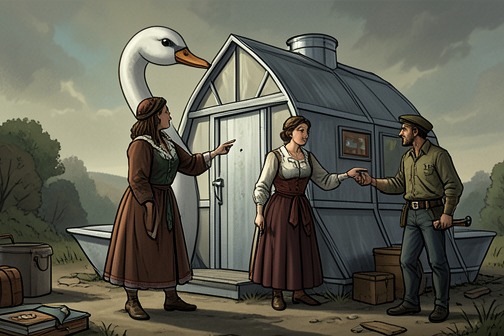
The conversation takes place at Hildy and Tam's Swan-Shaped Farmhouse, whose metal construction first draws Viola's attention. Todd sees a house shaped like a swan but does not know what a swan is. Viola, by contrast, recognizes the structure as a model of spacecraft: she asks whether it is an Expansion Three 500, and [Hildy](entity:character-recall-character-hildy-b5ad992c9fad) corrects her, identifying it as an older X Three 200. Their exchange shows how Viola's technical knowledge differs from Todd's and Hildy's everyday understanding of the objects around them.
Todd then realizes that Viola is a settler. He has already seen the small craft she crashed in and cannot reconcile its size with the idea that it carried settlers to a new home. Viola clarifies the distinction: that craft was only a scout, and her home ship is an Expansion Class Seven Colony Ship. The wreck, which had seemed to be the whole of her arrival, is revealed as only one part of a much larger migration.
## The approaching ship and the failed warning
Viola confirms that the colony ship is still in the sky and that more settlers are coming to New World. When Todd asks how many, she answers that there are thousands. Hildy adds that they will not arrive for months, giving the news a distant deadline without making it less consequential. The scale of the incoming population is far beyond the two travelers' immediate circumstances.
The delay does not offer a practical way to intervene. Viola explains that everything was broken in the crash and that she has no means of contacting the ship or warning its passengers not to come. She urges Todd to warn them, but the conversation establishes no channel by which he could do so. His quick disbelief and her insistence leave the appeal unresolved: the danger is recognized, yet the means of acting on it are absent.
The disclosure also shifts what Todd knows about Viola personally. Hildy and [Tam](entity:character-recall-character-tam-5f2cd5d6e8be) have said little while the travelers eat, and Todd senses that Viola had told Hildy about the settlers before she told him. He acknowledges that he had not asked, but the realization still stings. The scene thus joins an enormous public revelation to a smaller change in trust: Todd is no longer merely catching up with the facts of Viola's arrival, but discovering that she has shared part of her knowledge elsewhere.
## The history behind the news
Later disclosures supply a history that complicates any simple idea of New World as an empty destination. [Ben](entity:character-recall-character-ben-964df7d0a5ee) explains that the planet's living things communicate continuously, an environment the [Spackle](entity:character-recall-character-spackle-11fadbeae3d5) had adapted to but humans had not. As hardship increased, with crops failing and sickness spreading, blame was directed at the Spackle; prejudice became a movement and then a war. Humans had guns and the Spackle did not, though Ben makes clear that not all Spackle were killed and that survivors learned to keep their distance from humans.
The history of [Prentisstown](entity:location-recall-location-prentisstown-5c48443019b4) reveals a further form of violence within the human settlement itself. Todd tells Viola that Prentisstown's men killed its women after the war against the Spackle. Ben confirms that many men were persuaded by [Mayor Prentiss](entity:character-recall-character-mayor-prentiss-626bb6394987) and Aaron, and that men who tried to protect the women were killed too. Later, Todd learns that apparent disappearances had concealed executions: Mr Royal was killed on a boy's thirteenth birthday, and Mr Gault was executed after trying to flee through the swamp. The accounts connect the town's coming-of-age custom to a pattern in which boys were made killers and the men around them were complicit.
## Significance and unresolved consequence
These later revelations do not change the facts of Viola's announcement, but they deepen its stakes. The ship is not approaching an untouched world: it is coming to a planet shaped by ecological hardship, war, and violence among settlers. The contrast between thousands of people still on their way and the damaged society already there makes Viola's failed attempt to warn them consequential, even though the evidence gives no resolution to her appeal.
The scene also establishes a tension between knowledge and action. Viola can identify the ship, estimate the scale of its population, and understand that its passengers need a warning; the crash has nevertheless cut her off from the means to deliver one. Todd is asked to take up that responsibility before he accepts what she has told him. The approaching ship therefore remains both a concrete future arrival and an unanswered problem: months remain, but no way to reach the settlers has been found.
Event 10
Todd and Viola Reach Farbranch
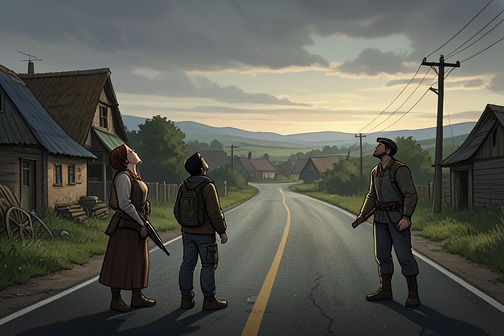
[Todd and Viola Reach Farbranch](entity:event-recall-event-todd-viola-farbranch-1534368d124b) is a guarded, unfinished arrival: the road brings Todd, [Viola](entity:character-recall-character-viola-01912bd40399), and [Hildy](entity:character-recall-character-hildy-b5ad992c9fad) to the settlement, but the first local encounter turns the threshold into a confrontation over identity, belonging, and who has the authority to offer protection. Instead of being received as travelers, Todd is immediately recognized as someone from [Prentisstown](entity:location-recall-location-prentisstown-5c48443019b4) and treated as a threat; Hildy’s defense of the two young travelers keeps that first challenge from becoming an attack, without resolving their welcome.
## The approach to [Farbranch](entity:location-recall-location-farbranch-faee876917dd)
The group’s arrival begins with sound. Todd and Viola hear [Noise](entity:state-recall-state-noise-4da2ff4fcf18) as they near Farbranch, and Hildy recognizes what it signals. The road then reaches the top of a small vale. That sequence marks a change in setting, but not a simple passage into safety: the settlement first announces itself through Noise, and the path into it becomes the site of a test.
Just before the encounter, Todd and Viola have heard one another express the same words through Noise. They look up and meet each other’s eyes, nearly smiling but stopping short. The brief, uncompleted gesture establishes a moment of mutual recognition between them on the approach to Farbranch. It is immediately displaced when Hildy stops speaking and a man steps onto the path ahead. Their attention shifts from the understanding between the two travelers to the danger posed by a stranger who has already judged their presence.
## Recognition and rejection
The man identifies the travelers’ association with Prentisstown and directs his attention at Todd. His Noise turns red and intensifies, while his face gives no sign of wanting to meet them. He declares that Todd is unwelcome and carries a large machete. Todd responds physically: his hand moves behind his rucksack toward his own knife. The confrontation is thus established through both speech and weapons, before either side has attempted a friendly introduction.
The dispute sharpens when the man, [Matthew Lyle](entity:character-recall-character-matthew-lyle-20e3aa97e9f5), challenges Hildy for bringing the pair into the village. Though he addresses her, he continues to watch Todd. Matthew reads Todd not as a lost boy but as a Prentisstown man, and describes his Noise as bearing the town’s stain. His judgment makes Todd’s origin seem, to Matthew, sufficient evidence against him. Hildy counters by describing Todd and Viola as lost young travelers and tells Matthew to stand aside; the disagreement is not merely over their presence, but over whether Todd should be seen through his birthplace or his age and circumstance.
## The law and Hildy’s protection
Matthew invokes the law, but Hildy answers that the law applies to men and insists that Todd has not yet become one. Todd adds that he has twenty-eight days remaining. Matthew dismisses the number: Todd’s countdown does not change how he is treated in Farbranch. The exchange makes age a contested boundary. Todd can name the time left to him, but Matthew refuses to let that measure determine the status or welcome he receives.
Hildy’s response is calm even as Matthew’s Noise grows more threatening. When the tension briefly subsides, his machete rises again; Hildy then states firmly that no one will threaten her guests while she is alive. Her intervention establishes a clear limit on Matthew’s conduct. He does not agree aloud or nod, but the encounter conveys that he understands her claim. His displeasure remains palpable in the way his Noise presses against Todd, so Hildy’s protection changes the immediate balance without changing Matthew’s hostility.
## An unresolved welcome
After holding Matthew to account for threatening her guests, Hildy does not end the encounter or remove the suspicion surrounding them. Matthew turns from Todd and points his machete toward Viola, asking who she is. The scene therefore closes on another challenge rather than on entry, acceptance, or a settled explanation. Hildy has defended both travelers, but Matthew’s attention has shifted to the second of them, leaving the terms of their reception open.
The arrival’s decisive tension lies in the gap between Hildy’s description of the pair as lost children and Matthew’s insistence that Todd embodies Prentisstown. The twenty-eight-day figure gives Todd a precise measure of the boundary he is nearing, but it offers no protection from Matthew’s immediate judgment. Farbranch is encountered not as an automatic refuge but as a community whose welcome is contested at its threshold; Hildy’s authority makes passage possible for the moment, while Matthew’s final question keeps the encounter unsettled.
Event 11
Prentisstown Army Attacks and Captures Farbranch
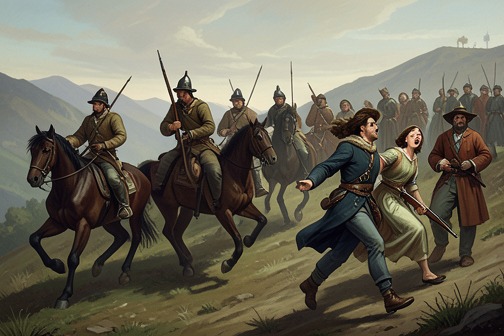
[Prentisstown Army Attacks and Captures Farbranch](entity:event-recall-event-farbranch-e086e1ac066e) marks the collapse of [Farbranch](entity:location-recall-location-farbranch-faee876917dd)’s security under the advance of [Prentisstown](entity:location-recall-location-prentisstown-5c48443019b4)’s full force. What [Todd Hewitt](entity:character-recall-character-todd-hewitt-137d446caea3) and [Viola](entity:character-recall-character-viola-01912bd40399) had understood as a pursuing posse proves to be an army: from a hillside, they see Farbranch’s men and women driven back by mounted leaders and ranks of armed men. The attack changes the immediate question from whether Farbranch is threatened to whether it can withstand an overwhelming assault—and leaves Todd and Viola to turn away from the people they have just watched fall.
## Warning and Background
The assault first reaches Todd through [Francia](entity:character-recall-character-francia-7e49fba0abd3)’s warning. After Todd points to the machete and acknowledges what has happened, Francia studies him, then tells him that they are under attack. She identifies the attackers as Prentisstown men—the posse pursuing him—and makes clear that the danger extends to the whole town. The news breaks into an already uncertain moment: Todd does not know whether Matthew is alive or dead, and believes he will never find out. Francia’s warning shifts attention from that unresolved personal consequence to the danger facing Farbranch as a community.
The word posse initially gives the attack a limited shape: a band of pursuers on Todd’s trail. But Francia’s next explanation enlarges the threat. These men are attacking Farbranch itself, not simply trying to catch one fugitive. The distinction becomes decisive when Todd and Viola reach the hill above the valley. They hear another rattle of gunfire before they see the battle, so the violence is first registered as sound and only then made visible. The rumours Francia had heard, previously uncertain reports, are confirmed by what appears across the valley.
## The Army Comes into View
From the top of the hill, Todd and Viola see Farbranch’s men and women running back down the slope in retreat. Over the crest comes a line of mounted men—Todd counts them as five, then ten, then fifteen—followed by rows of men marching five across with guns. At the front are horses Todd takes to be the Mayor’s. The ordered ranks and the number of riders overturn the impression of a small posse: Todd recognizes the advancing force as Prentisstown itself, every man from the town, rather than a handful of pursuers.
The scale of the attack makes the imbalance explicit. The invading force has three times as many people as live in Farbranch, and three times as many guns. These comparisons turn the distant formation into a measure of what the settlement is up against. The attack is not presented as an evenly matched contest whose outcome remains open. Gunshots sound as Farbranch’s people run toward their houses, and Todd and Viola see men and women fall. Retreat offers no simple escape from the force following them over the hill.
## Imminent Capture and Its Cost
Todd judges that Prentisstown will take Farbranch easily, before an hour has passed. This is his assessment from the hillside, not a scene of the town’s eventual surrender: he and Viola witness the assault and its consequences as they unfold, while the capture remains imminent. The distinction matters to the scene’s perspective. Its immediate evidence is the retreat, the advancing ranks, and the people falling under gunfire; its anticipated outcome follows from the overwhelming disparity in numbers and weapons.
The attack also gives the rumours their full meaning. Francia had heard that Prentisstown men were coming, but what crosses the hill is far larger than a posse. The revelation is both military and communal: Farbranch is facing the combined force of the town, not an isolated pursuit that might be evaded or contained. The settlement’s people are already being driven back toward their houses, while the army continues its advance. The speed of Todd’s prediction—before the hour is through—underscores how little time the defenders appear to have.
## Todd and Viola Leave
Todd watches through binoculars, then lowers them, wipes his eyes with his sleeve, and hands them to Viola. He tells her they must go. The small sequence of gestures makes leaving an action rather than an abstract decision: he has looked long enough to understand the danger, but cannot remain watching without risking their own safety. Viola takes the binoculars and apologizes, having seen the effect of the attack in Todd’s [Noise](entity:state-recall-state-noise-4da2ff4fcf18). Her response registers that the scene is not only visible to them; Todd’s distress is also exposed to her.
Todd answers that the harm has already happened and urges them onward, adjusting the rucksack as he moves. His stated reason is to avoid putting them in still greater danger, not indifference to Farbranch’s people. The departure leaves the defenders behind at the moment of their retreat and gives the scene its painful turn: the pair can witness the attack, recognize its likely outcome, and still have to leave. Farbranch’s fall is thus established through both the army’s advance and the observers’ forced withdrawal, while the immediate narrative emphasis stays on what Todd and Viola can see and do from the hillside.
Event 12
Todd and Viola Cross the Giant Herd
[Todd Hewitt](entity:character-recall-character-todd-hewitt-137d446caea3) and [Viola](entity:character-recall-character-viola-01912bd40399) encounter the [Here-Singing Herd Beasts](entity:creature-recall-creature-here-bfa4561f4eaf) from a hilltop, where the animals’ immense crossing turns the landscape into a soundscape of collective life. Their call, [Here](entity:expression-recall-expression-here-6ac9216c844b), is unlike the intrusive [Noise](entity:state-recall-state-noise-4da2ff4fcf18) of human thought: it is shared across thousands of animals and makes belonging seem audible. The scene offers the travellers a moment of emotional recognition, then shifts abruptly when [Wilf](entity:character-recall-character-wilf-4965a709f689) arrives with news of an army advancing from [Prentisstown](entity:location-recall-location-prentisstown-5c48443019b4) and a warning that [Brockley Falls](entity:location-recall-location-brockley-falls-a3319bfdd380) must be alerted.
## The herd in the landscape
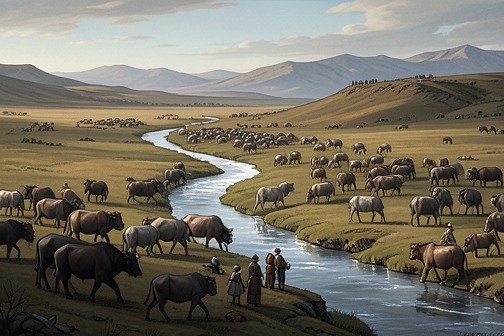
The encounter begins with sound before the animals are visible. As Todd and Viola travel, a strange, nearly wordless Noise crests a hill and rolls towards them, at once single-minded and multitudinous. Its source becomes clear when they reach the top: a plain stretches below, with a river running through it, and thousands of animals moving from one side of the water to the other. The silver line of the river and the herd’s movement across the open plain make the gathering appear to extend from one horizon to the other.
The animals are immense, roughly four metres tall, with shaggy silver fur, thick fluffed tails, curved white horns, and long necks descending from broad shoulders. They lower their wide lips to graze as they trudge over dry ground, then drink while crossing the river. This is not a single animal or a small group that can be understood at a glance: the visible creatures and their sound form a moving multitude. The landscape remains legible—the plain, the river, the grazing ground—but the herd’s scale changes how Todd and Viola experience it, making a familiar journey suddenly feel like a meeting with an entire community.
## A collective call
The herd’s Noise is made up of many voices, arriving at different times and pitches, yet joined by a single word: Here. Viola identifies what they are hearing as the animals singing it to one another. The word is at once a call and a shared signal, repeated across the herd as it moves over the plain and through the river. Its many notes do not erase the individuals making them; instead, the voices weave together, binding the animals into a group.
That sound differs sharply from the human Noise Todd knows. In Prentisstown, the thoughts of its 146 remaining men can overwhelm him like a flood, and even [Mayor Prentiss](entity:character-recall-character-mayor-prentiss-626bb6394987)’s efforts to impose order on Noise take the form of disciplined counting and chants. The herd’s sound is also collective, but the scene presents its unity not as imposed control: its voices converge in a call exchanged among the animals as they move together. The contrast lies in what the sound makes possible. Human Noise exposes private thoughts, memories, plans, and lies; the herd’s shared call gives Todd and Viola an impression of connection rather than exposure.
## Belonging heard and felt
Todd understands the song through its effect on the listeners as much as through its word. It resembles a family song in which all is well, a sound of belonging that seems to make a listener belong simply by hearing it. Its emotional force reaches both travellers: Viola covers her mouth, her eyes wet, yet smiles behind her hand. Todd, too, is struck by the sound. The scene records no explanation from the herd and offers no translation beyond Here; its meaning emerges through the repeated call and the response it draws from the humans who hear it.
That response is especially significant against the world of isolation surrounding the journey. Todd has known a town whose communal Noise is oppressive, and he has learned that men can conceal intentions even when thoughts are audible. Here, by contrast, the call does not dissolve into the confusion of many competing voices. Its repetition makes a shared presence perceptible. The song does not change the travellers’ circumstances or promise that they will be safe, but it briefly presents a form of collective life that feels sustaining rather than threatening.
## Wilf’s warning
The moment is interrupted by a human voice from the travellers’ left. Wilf is driving an empty cart pulled by two oxen, and a shotgun rests on the seat beside him. Todd turns towards the newcomer with his hand going to his knife; the song’s emotional openness gives way to caution. Wilf’s arrival brings the scene back from the herd’s expansive, unified sound to the immediate questions of human danger and what the travellers should do next.
Wilf has heard stories carried down the river about an army coming out of the swamp, taking settlements, and growing as it advances. Viola confirms that they have seen it and tells him to warn Brockley Falls. When he asks whether the army is large, she answers that it is very big and repeats that he needs to warn the settlement. The scene does not establish whether Wilf delivers that warning. It does establish that news of the advancing force is spreading through local conversation, and that the threat has become urgent enough for Viola to pass on what she knows.
## Narrative significance
The episode places two kinds of collective sound beside one another. The herd’s voices form an unfamiliar call that makes kinship feel possible; Wilf’s reports, by contrast, carry news of an expanding human conflict from settlement to settlement. The transition is immediate: the travellers move from witnessing a multitude bound by song to speaking with a man who must be warned about an army. The natural world is not merely scenery around the human plot, since its own sounds convey a mode of connection that Todd and Viola can feel even without sharing the animals’ language.
The scene also develops a recurring concern with how sound shapes action. Noise can overwhelm, be deliberately ordered, or circulate as information; the herd’s song gives it another function, one based on recognition and communal presence. Yet the encounter does not suspend the danger beyond the hill. Wilf’s warning returns the travellers to the practical urgency of the journey, while the herd’s call remains a brief but consequential contrast: a vision of togetherness heard at the same moment that human settlements face a growing threat.
Event 13
Todd and Prentiss Jr. Fight in the Rain
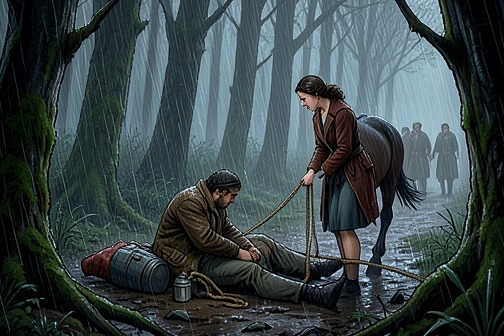
[Todd and Prentiss Jr. Fight in the Rain](entity:event-recall-event-todd-prentiss-jr-fe0f1dc68c77) is a turning point in [Todd Hewitt](entity:character-recall-character-todd-hewitt-137d446caea3) and [Viola](entity:character-recall-character-viola-01912bd40399)’s flight: a capture attempt becomes a confrontation in which Todd can strike back, while Viola’s intervention prevents him from turning that victory into a killing. The scene moves from pursuit and helplessness to brief control, then ends on the unresolved question of whether Todd can refuse the violence being demanded of him.
## Pursuit and Capture
The confrontation begins as [Mr Prentiss Jr](entity:character-recall-character-mr-prentiss-jr-d2c05f47a7e1) closes in on Todd and Viola through the rain. His voice carries clearly above the storm, the galloping horse, and the river, making his approach impossible to mistake. Todd and Viola try to reach the deeper woods by taking a winding route over logs and through bushes, with [Manchee](entity:character-recall-character-manchee-553c4e158d6f) running behind them. But the strip of ground between the road and the river narrows, and the road bends toward the water: to reach the woods on the other side, they must cross in front of their pursuer.
Viola makes it onto the road as Mr Prentiss Jr rounds the bend, but he throws a weighted rope around Todd’s legs. Todd falls, and his rucksack pulls against him as it comes off his back. He calls for Viola to run. She stops long enough to look at him, then disappears into the woods; Manchee instead returns to Todd. The attacker is on a white horse with his rifle ready, and Todd understands that the rope has caught him as a hunter might catch an animal. The escape has become a capture, and Todd is left on the ground beneath the armed rider.
## Todd Reverses the Encounter
Mr Prentiss Jr taunts Todd with a threat to tie him up and then find Viola. Todd waits until the pursuer is close, pushes himself up, and launches into him, knocking him from the horse. He follows with blows, retrieves his knife, and kicks the rifle away. The encounter’s balance changes quickly: the weapon and horse no longer give Mr Prentiss Jr the control he had while Todd was caught.
Todd then scares the horse by waving his arms and shouting about a snake. It bolts down the road without its rider. With the horse gone and the rifle out of reach, Todd has a chance to question Mr Prentiss Jr. Asked why his father wants them, the captive corrects Todd: [Mayor Prentiss](entity:character-recall-character-mayor-prentiss-626bb6394987) wants Todd alone, not the two of them. That answer reveals the pursuit’s stated target, but it does not make Todd’s danger less immediate. Mr Prentiss Jr also claims that [Ben](entity:character-recall-character-ben-964df7d0a5ee) and [Cillian](entity:character-recall-character-cillian-746514cf96d5) begged for mercy before he shot them. The claim is delivered to provoke Todd; the scene presents it as Mr Prentiss Jr’s taunt, not as independently confirmed testimony.
## Viola’s Intervention
The reference to Ben and Cillian makes Todd grip his knife and prepare to strike. As Mr Prentiss Jr turns the blade toward Todd’s cheek, a wash of silence reaches him from behind. Todd recognizes Viola’s presence through the sudden quiet, and she tells Mr Prentiss Jr to step back. Her arrival changes the confrontation: Todd is no longer alone with his captor, and the silence associated with Viola signals that she is close even before he turns to her.
Viola throws a small device onto Mr Prentiss Jr’s chest. It has wires and a plastic bulb, and he assumes it has failed when it remains stuck to him. A sudden flash and electrical discharge prove otherwise. Viola pulls Todd backward by the collar as Mr Prentiss Jr spasms and falls face-first into the mud. She had feared that the surrounding water might put both her and Todd at risk, but acted when he was about to cut Todd. The device does not merely defeat the pursuer: Viola’s decision also prevents Todd from having to face the immediate threat by himself.
## The Knife and the Unresolved Choice
After Mr Prentiss Jr falls, Todd has his knife in hand and holds it above him. Viola tells Todd that he is not a killer. Todd turns on her in anger, rejecting the description and telling her never to say it. Her words do not calm him; they touch the identity and violence the scene has made impossible to ignore. He has defended himself, attacked his captor, and now stands over a defeated opponent with a weapon. The opportunity to strike is therefore also a test of what he will do with the power he has gained.
The scene does not show Todd killing Mr Prentiss Jr. Instead, it closes with Viola reaching out and trying to calm him while his anger remains evident. The shift is consequential but incomplete: the pair have survived the capture attempt, and Viola has interrupted Todd at the moment he might have escalated the fight, yet the threat of Mayor Prentiss’s pursuit persists. Rain, road, river, and woods have shaped the action as a narrowing route toward escape; the final obstacle is no longer simply the armed pursuer, but Todd’s response to the violence that has brought him there.
Event 14
Todd Kills a Spackle
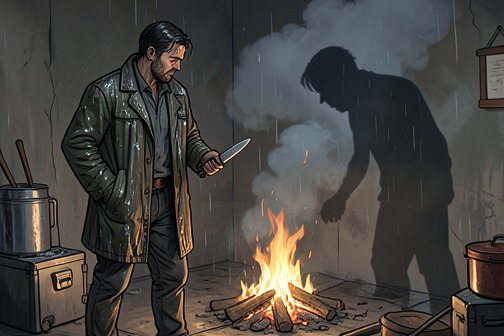
[Todd Kills a Spackle](entity:event-recall-event-todd-spackle-262deb442fa7) is a turning point in [Todd Hewitt](entity:character-recall-character-todd-hewitt-137d446caea3)’s journey: faced with a survivor of the people he had been taught to consider enemies, he acts on fear before he can question it. The killing changes a presumed truth into a present reality—the [Spackle](entity:character-recall-character-spackle-11fadbeae3d5) are not all gone—and makes Todd confront the violence he has carried forward from the world around him.
## The encounter at the campsite
Todd and [Viola](entity:character-recall-character-viola-01912bd40399) come upon a campsite unexpectedly. A fire is burning, and a man is preparing a fish. Todd recognizes him as a Spackle almost at once, before he has time to reconsider what that recognition means. The discovery is especially charged because the Spackle appears to belong to a past Todd thought had ended: the human war was understood to have killed them all.
The Spackle’s [Noise](entity:state-recall-state-noise-4da2ff4fcf18) reaches Todd through the rain, but not as clear words. It comes as distorted images, including pictures of Todd and Viola facing him and of the knife in Todd’s hand. Todd briefly finds these images readable. That moment of apparent understanding does not make him pause; instead, when he sees the Spackle moving toward a spear, he takes the movement as a threat. The scene turns on that interpretation. The spear is real, but the evidence does not establish that the Spackle intends to attack them.
## The killing and Viola’s objection
Todd charges before the Spackle can reach the spear. His Noise carries images and feelings drawn from his own past, including his failures to use the knife, and his thoughts narrow toward proving himself a killer. He knocks the Spackle down and realizes that the other is weaker than he is. The realization gives him a chance to stop, but it does not halt his advance.
When the Spackle tries to crawl away, Todd drags him back and prepares to use the knife. Viola, who has been with [Manchee](entity:character-recall-character-manchee-553c4e158d6f), grabs Todd’s arm and tries to pull it away from the Spackle. Todd pushes against her effort to restrain him. He then stabs the Spackle, who dies despite Todd’s continued violence. The account centers not on a contest between equal attackers but on Todd’s decision to continue against someone he has already recognized as physically weaker and trying to retreat.
Viola immediately disputes Todd’s claim that the Spackle would have killed them. She has seen fear in him, while Todd insists that he was going for the spear. Her objection challenges the certainty Todd has built from the movement he witnessed: reaching for a weapon does not, by itself, prove what the Spackle meant to do. When Viola asks whether Todd had been taught that all the Spackle were killed in the war, his anger falls away. He understands that he has again accepted as truth something that was not true, and recognizes the person he has killed as a survivor rather than the enemy his assumptions supplied.
## The violence behind the assumption
Later, [Ben](entity:character-recall-character-ben-964df7d0a5ee) explains the history that gives Todd’s error its wider context. Life on the [New World](entity:location-recall-location-new-world-7c8068dcbb7d) had grown harder, with failing crops, sickness, and little prosperity. Blame directed at the Spackle developed into a movement and then a war. Humans had guns and the Spackle did not; the result was a near-destruction, not the complete extinction Todd had believed. Those who survived learned to keep away from humans. The campsite encounter therefore breaks through both a mistaken belief and the distance that had helped sustain it: a Spackle is present, communicating, and afraid, rather than an already-erased enemy from the past.
That history makes the killing part of a larger pattern of violence justified by collective blame. Ben also confirms that, after the Spackle were killed, men in [Prentisstown](entity:location-recall-location-prentisstown-5c48443019b4) killed women and men who tried to protect them, under the influence of [Mayor Prentiss](entity:character-recall-character-mayor-prentiss-626bb6394987) and Aaron’s preaching. The later revelations about Prentisstown’s coming-of-age killings show another form of violence made communal: Mr Royal was killed by Seb Mundy on the boy’s thirteenth birthday, and Mr Gault was executed after trying to flee, with [Mr Prentiss Jr](entity:character-recall-character-mr-prentiss-jr-d2c05f47a7e1) made to torture him on his own thirteenth birthday. These events are not the same as Todd’s encounter, but they deepen its significance within a society where killing is repeatedly made into proof of belonging or manhood, and responsibility is spread across those who watch or participate.
## Consequences and significance
Todd’s immediate response is to identify himself as a killer. That recognition follows his realization that the Spackle was frightened, and it reverses the certainty with which he acted: what he had treated as self-defense now appears as a fatal mistake made under the influence of fear, anger, and inherited assumptions. Viola’s distress marks the distance between their interpretations. She sees the Spackle’s fear; Todd initially sees only a threat, then has to face what his own action has made undeniable.
The killing also gives personal force to the book’s account of the war. The history Ben recounts describes how hardship was redirected into blame and how unequal power made that blame lethal. At the campsite, the same movement from assumption to violence occurs on an individual scale: Todd sees a weapon, decides what its presence means, and acts before he knows the Spackle’s intention. The Spackle’s death does not resolve the history between the peoples; it reveals that the history remains active in Todd’s understanding and choices.
By linking this encounter with the later account of Prentisstown’s killings, the narrative places Todd’s act within a culture that teaches violence and then distributes its guilt. Ben names the community’s complicity in those other deaths, while Todd’s killing forces him to acknowledge his own part in the pattern. The event is therefore both an irreversible loss and a moral awakening: Todd cannot undo what he has done, but he can no longer mistake the inherited story of an extinct enemy for the truth before him.
Event 15
Noise Emerges on the New World
[Noise Emerges on the New World](entity:event-recall-event-d375aed1f3f4) is the sudden discovery that the planet continuously transmits thought among men, a natural condition mistaken at first for a biological attack. Recalled by [Ben](entity:character-recall-character-ben-964df7d0a5ee), the event overturns the colonists’ expectations of privacy and forces scattered communities to find ways to live with an environment that never stops communicating.
## Causes and Discovery
The colonists encountered [Noise](entity:state-recall-state-noise-4da2ff4fcf18) after landing on the [New World](entity:location-recall-location-new-world-7c8068dcbb7d), roughly ten years before [Todd Hewitt](entity:character-recall-character-todd-hewitt-137d446caea3) was born. Ben clarifies that the [Noise germ](entity:concept-recall-concept-noise-germ-0b0f8cbc89b9) was not a [Spackle](entity:character-recall-character-spackle-11fadbeae3d5) weapon: it already existed in the planet’s air and was a naturally occurring phenomenon. Within a day of leaving their ships, the colonists could hear one another’s thoughts. What seemed like a sudden outbreak was therefore an encounter with a condition that had always belonged to the planet, not an attack launched during the war.
The effect did not reach everyone. Men could hear one another; women could not. The reason remained unknown even to the colonists’ scientists and doctors, whose expertise was largely agricultural and who could find no explanation. [Viola](entity:character-recall-character-viola-01912bd40399)’s silence during Ben’s account makes that distinction present in the conversation as well as part of the remembered history: the Noise is audible around her, but it does not expose her thoughts.
## Immediate Upheaval and Adaptation
The first response was chaos and confusion. Some men scattered from [Haven](entity:location-recall-location-haven-cdfff42acfaa) into distant communities, moving away as roads were cut, while others gradually recognized that there was no way to escape the condition itself. Communities then tried different ways of living with Noise. The disruption extended beyond human society: colonists also discovered that livestock, pets, and local creatures communicated with one another.
Ben describes this as a planetary condition rather than a human peculiarity. Everything on the New World communicates, continuously, whether or not anyone wants the information. The Spackle had evolved to live with that constant exchange; the human colonists had not. For them, too much information became Noise, and there was no lasting interval in which it simply stopped. The event thus changed not only what people could know about one another, but the basic conditions under which they could think and live together.
## Social Responses and Uneven Consequences
The communities’ attempts to manage Noise took different forms. In [Farbranch](entity:location-recall-location-farbranch-faee876917dd), music played throughout the day and night. [Doctor Snow](entity:character-recall-character-doctor-snow-0553c58bef71) explained that its purpose was to preserve privacy for men’s thoughts. Todd recognized the strategy from the pub in [Prentisstown](entity:location-recall-location-prentisstown-5c48443019b4), where constant music had also been used to drown out Noise. The parallel shows that sound could serve as a deliberate barrier: music did not remove the underlying condition, but it could mask its constant mental exposure.
Prentisstown developed a contrasting response around [Mayor Prentiss](entity:character-recall-character-mayor-prentiss-626bb6394987). His Noise was unusually clear, and he believed that order could be imposed on Noise and that it might be harnessed and put to use. At the Mayor’s House, he and the men closest to him, including his deputies, practiced counting exercises, imagined perfect shapes, and recited orderly chants. Their repeated sequence, [I AM THE CIRCLE AND THE CIRCLE IS ME](entity:expression-recall-expression-i-am-the-circle-an-1d42347e02a4), gave these exercises the character of discipline and preparation. To Todd, the performance suggested that Mayor Prentiss was shaping a small army and forging a weapon out of Noise. Where Farbranch used music to shelter private thought, the Mayor sought to organize the very force that made privacy so difficult.
## The Noise as Lived Environment
In Prentisstown, the cost of constant exposure is rendered as an overwhelming soundscape. Todd hears the thoughts of all 146 men who remain, their Noise seeming to pour down the hill like a flood or a fire. It consists not only of words, voices, moans, songs, and cries, but also of images: memories, fantasies, secrets, plans, and lies. Noise reveals thought, but it does not guarantee truth. A person can bury one thought beneath another or persuade himself that the opposite is true, leaving listeners to distinguish what is real within the flood.
The novel also contrasts this mental din with physical sound. Behind the waterfall, the roar becomes so immense that Noise is obliterated; the resulting quiet is described as the quietest Todd has ever felt. The contrast does not undo the planet’s communicative condition. Instead, it shows how completely that condition has become part of human perception: overwhelming natural sound can momentarily eclipse the mental torrent and make quiet feel newly possible.
Event 16
The Spackle War on the New World
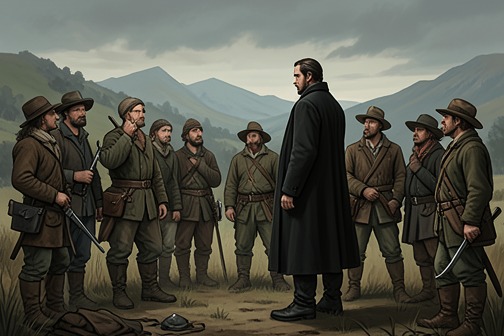
[The Spackle War on the New World](entity:event-recall-event-3a615fd1f66f) is the turning point through which hardship is redirected into violence against an alien people—and the beginning of a history whose consequences reach into [Prentisstown](entity:location-recall-location-prentisstown-5c48443019b4)’s later murders. As [Ben](entity:character-recall-character-ben-964df7d0a5ee) explains the past to [Todd Hewitt](entity:character-recall-character-todd-hewitt-137d446caea3) and [Viola](entity:character-recall-character-viola-01912bd40399), the war emerges not as an isolated clash but as the result of worsening conditions, a preaching that assigns blame, and a profound imbalance in force. Its aftermath also makes clear that the violence does not stop with the [Spackle](entity:character-recall-character-spackle-11fadbeae3d5): the same town that helps destroy them goes on to kill its own women and their defenders.
## Causes and the turn to war
The settlers had imagined [New World](entity:location-recall-location-new-world-7c8068dcbb7d) as a new beginning after leaving the corruption and sin of [Old World](entity:location-recall-location-old-world-ab33a7b27714). In Prentisstown, Aaron’s regular sermons evoke a new Eden founded on purity and brotherhood, but this promise sits against a harsher reality. As Ben recounts, crops fail, sickness spreads, and prosperity does not arrive. The hope of a purified life has not made the settlement secure; hardship instead creates conditions in which a public explanation for suffering can take hold.
That explanation directs blame outward. Viola identifies the target as the aliens, and Todd recognizes them as the Spackle. Ben confirms that blaming the Spackle became more than a prejudice: preaching spread, became a movement, and the movement became war. The sequence matters. Misfortune is not shown to prove the accusation; rather, accusation turns shared difficulty into a reason to act against an already vulnerable group. The war’s cause, as the account presents it, is therefore both material and ideological: hardship provides the setting, while blame gives it a target.
## The war and its unequal outcome
Ben describes the conflict through its decisive imbalance. The humans had guns; the Spackle did not. In his account, the Spackle did not stand a chance, and their defeat is treated as the end of the war. The briefness of that explanation leaves no battle spectacle at its center. Instead, the emphasis falls on the difference in power and on the outcome that difference produces: an armed human population defeats an unarmed people.
Todd interrupts the sense of complete destruction by pointing out that not all the Spackle were killed. Ben agrees. Some survive, but survival comes with separation: the remaining Spackle learn not to come close to men again. The war thus ends in military defeat without erasing the people it targets. Its continuing consequence is a world in which survivors keep their distance from humans, carrying the effect of the violence into the uneasy relations that follow.
## Violence returns to Prentisstown
Ben’s account does not allow the defeat of the Spackle to stand as the last atrocity. Todd states that after the war, the men of Prentisstown killed the town’s women. Ben clarifies that not every man took part, but many were swayed by [Mayor Prentiss](entity:character-recall-character-mayor-prentiss-626bb6394987) and Aaron’s preaching. The victims included the women and the men who tried to protect them. The revelation turns the war’s aftermath into a second history of collective violence, this time directed inward at the settlement’s own people.
The connection is ideological as well as chronological. Aaron had preached that what was hidden must be evil, and Mayor Prentiss’s influence helped draw men into the killings. The evidence does not make the war and the later murders identical events; it shows a community in which religious language and authority can help make violence seem permissible, first against the Spackle and then against women and their protectors. Todd learns that his mother was among the women killed. Ben confirms it without elaboration, so the historical account becomes personal: the violence that shaped the town is also part of Todd’s family history.
## Memory, complicity, and the war’s legacy
The history of the war is disclosed in conversation rather than staged as a battle scene. Ben recounts what happened while Todd and Viola listen, and the account moves from public hardship to collective blame, military defeat, surviving Spackle, and violence within Prentisstown. That order steadily changes the scale of what Todd understands. What begins as an explanation of a war becomes an account of the society that made both that war and later killings possible.
Later revelations about Prentisstown’s coming-of-age killings deepen the picture of a town organized around shared guilt. Men and boys known to Todd were killed in staged executions, and the community treated victims as though they had disappeared or had been selected for punishment. Todd understands the resulting structure as one in which everyone is complicit and guilty, apart from himself. These later murders are not part of the [Spackle War](entity:event-recall-event-spackle-war-8bca5a1a44f3), but they show the persistence of the town’s violence after the war and the coercive community it helped form.
The episode also complicates any claim that the settlement’s language of brotherhood created genuine solidarity. Prentisstown’s church preaches communal unity, while Mayor Prentiss’s men practice ordered exercises and repeat a creed of collective falling and rising. Against those promises, the history Ben tells is one of unequal force, scapegoating, and people killed by their neighbors. The Spackle War is decisive not only because the humans defeat the Spackle, but because the account exposes the pattern of blame and authority that continues to shape life after the fighting ends.
Event 17
The Prentisstown Massacre
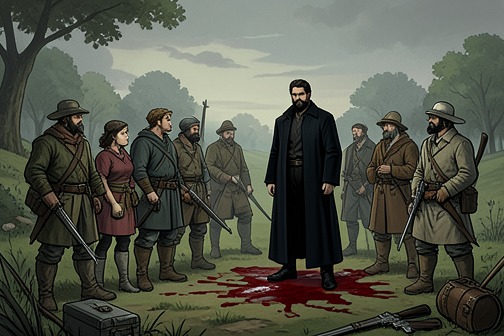
[The Prentisstown Massacre](entity:event-recall-event-e9a2ed48ce89) destroyed the community of New Elizabeth and created the conditions for [Prentisstown’s isolation](entity:state-recall-state-prentisstown-60df33718dd4) and violence. As [Ben](entity:character-recall-character-ben-964df7d0a5ee) recounts the past to [Todd Hewitt](entity:character-recall-character-todd-hewitt-137d446caea3) and [Viola](entity:character-recall-character-viola-01912bd40399), the massacre emerges not as an unexplained eruption but as the culmination of hardship, blame directed at the [Spackle](entity:character-recall-character-spackle-11fadbeae3d5), and preaching that made violence seem justified. Its aftermath reached beyond those killed: survivors were confined by law, the town’s history was concealed, and killing became embedded in the next generation’s passage into adulthood.
## Causes and Background
The history begins with the [Noise germ](entity:concept-recall-concept-noise-germ-0b0f8cbc89b9), which Ben clarifies was not a weapon used by the Spackle. It was already present in the air when the human colonists landed on [New World](entity:location-recall-location-new-world-7c8068dcbb7d). Within a day, people could hear one another’s thoughts. The planet’s living things communicated continuously; the Spackle had evolved within that condition, while humans were unprepared for the unceasing flow of information. For humans, too much information could become [Noise](entity:state-recall-state-noise-4da2ff4fcf18) and contribute to madness. That distinction matters to the history that followed: the Spackle were blamed for a condition they had not caused.
Over the years, life on New World grew harder. Crops failed, sickness spread, and prosperity remained out of reach. In that climate of accumulated disappointment, preaching took hold that assigned blame to the aliens, the Spackle. According to Ben, accusation became a movement, and the movement became a war. The imbalance of force was decisive: the humans had guns, while the Spackle did not. Ben describes the result as the end of the Spackle, though Todd Hewitt insists that not all had died. The survivors kept their distance from humans, a separation that preserved the consequences of the war long after its immediate violence.
The massacre in [Prentisstown](entity:location-recall-location-prentisstown-5c48443019b4) followed this larger pattern of collective blame, but its victims were the town’s own women and the men who attempted to protect them. Todd Hewitt names that sequence as the men’s killing of the women after the Spackle had been killed. Ben confirms that many men participated, influenced by [Mayor Prentiss](entity:character-recall-character-mayor-prentiss-626bb6394987) and Aaron’s preaching. Aaron’s claim that what was hidden must be evil supplied a moral rationale for suspicion and violence. The account identifies both ideological influence and individual responsibility: the preaching helped sway the killers, but it was men of Prentisstown who carried out the killings.
## The Attack on New Elizabeth
Some residents recognized the danger early. [Jessica Elizabeth](entity:character-recall-character-jessica-elizabeth-3f4ccaa33110), the mayor of New Elizabeth, saw how events were turning and organized some of the girls and younger boys to flee across the swamp. She had not yet escaped herself with the women and the men who had not lost their minds when Mayor Prentiss’s men attacked. The account establishes the interruption of the escape effort, but does not detail Jessica Elizabeth’s subsequent fate.
The failed flight marked the destruction of New Elizabeth as a community. Todd Hewitt understands the transformation in stark terms: New Elizabeth became Prentisstown. The change was more than a new name. It signaled the loss of the former town’s civic life and the consolidation of power under Mayor Prentiss. Todd Hewitt’s mother had not believed that the violence would reach this point. When escape became impossible and her son was too young to be sent away, she entrusted him to Ben and [Cillian](entity:character-recall-character-cillian-746514cf96d5) to keep him safe. That decision links the massacre directly to Todd Hewitt’s childhood and to the protectors who later tell him what happened.
## Punishment and Isolation
The people who escaped carried news of Prentisstown’s crimes beyond the swamp. In response, all men from Prentisstown were declared criminals. The wider New World authorities did not launch another war against them or confine them in a prison; instead, the law stipulated that any man from Prentisstown who crossed the swamp would be executed. The community was left to itself under that threat. The law imposed isolation rather than repairing the violence or bringing the perpetrators to justice.
That punishment also shaped the town’s later history. The men could not simply leave, and the threat of execution made the swamp a legal boundary around their lives. The distinction between the men who had committed atrocities and those who had not was collapsed into a collective sentence. Ben’s account makes the consequence plain: the escaped residents’ testimony exposed the crime, but the resulting policy confined the population rather than distinguishing individual responsibility or offering a route back into the wider society.
## Concealed Violence and Continuing Consequences
The massacre’s legacy is inseparable from the later killing custom that Todd Hewitt discovers was concealed beneath the town’s stories of men who had disappeared or died by their own hand. Mr Royal, Todd Hewitt’s former schoolteacher, was said to have shot himself after turning to whisky. In fact, Seb Mundy killed him on Seb Mundy’s thirteenth birthday, with the other men watching. Mr Gault, whose sheep flock Todd Hewitt’s group took over after he supposedly disappeared, had attempted to flee through the swamp. Mayor Prentiss found him and arranged for [Mr Prentiss Jr](entity:character-recall-character-mr-prentiss-jr-d2c05f47a7e1) to kill him on his thirteenth birthday. These were separate later killings, not part of the original massacre, but their concealment shows how the town’s violence persisted across generations.
When no captured escapee was available for a boy’s thirteenth birthday, the men could select someone they disliked and claim he had disappeared. A victim’s life was assigned to a boy to end alone, while the community watched. The custom turned killing into a public measure of adulthood and implicated those who observed, arranged, or accepted it. Todd Hewitt’s realization that everyone was complicit, except himself, exposes the distinction between the town’s official explanations and its actual practices.
## Retelling and Significance
The massacre reaches the reader through a charged act of disclosure. Ben takes a deep breath before explaining the origin of the Noise germ and the chain of events that led to war and murder. He pauses as he remembers; Viola’s silence and her correction that the germ did not affect everyone sharpen the account’s attention to what had been excluded from the familiar story. Later, Todd Hewitt names the killing of the women aloud, and Ben confirms it. The pauses and confirmations make the history a painful revelation rather than a detached chronicle.
The account revises several beliefs at once: the Noise germ was natural rather than Spackle warfare; the town’s women were killed by its men; Todd Hewitt’s mother was among the victims; and the men’s isolation followed the exposure of their crimes. It also connects the massacre to the later concealment of deaths and the ritualized killing of boys’ chosen victims. The sequence shows how hardship and scapegoating can prepare the ground for violence, while punishment without reintegration can preserve a closed society in which violence is repeated and shared responsibility is obscured.
Event 18
Prentisstown's Coming-of-Age Killing Ritual
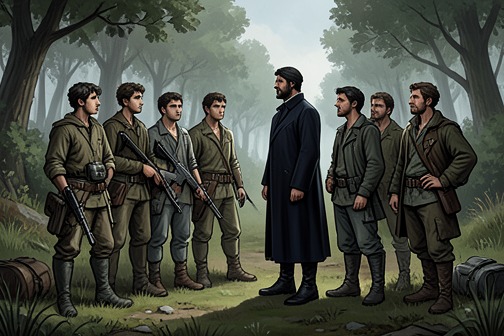
[Prentisstown's Coming-of-Age Killing Ritual](entity:event-recall-event-e7d3db88f88a) is the town’s system for making boys into men through murder. Each boy is made to kill a man alone, and the community treats the victim’s death as the threshold of adulthood. When [Todd Hewitt](entity:character-recall-character-todd-hewitt-137d446caea3) learns how the ritual worked, the apparent disappearances of men he had known resolve into a pattern of staged lies and assigned killings. The ritual’s force lies not only in its victims, but in how it makes the young perpetrators complicit in the society that has arranged their actions.
## Origins in a climate of blame
[Ben](entity:character-recall-character-ben-964df7d0a5ee) places the ritual’s history within a broader account of hardship and violence on the [New World](entity:location-recall-location-new-world-7c8068dcbb7d). Crops failed, sickness spread, and prosperity did not arrive. In that climate, a preaching began to blame the [Spackle](entity:character-recall-character-spackle-11fadbeae3d5); Ben describes how accusation grew into a movement and then a war. The humans had guns and the Spackle did not, and Ben says the result was devastating, though not every Spackle was killed. Survivors learned to keep their distance from humans.
The account then turns to violence within [Prentisstown](entity:location-recall-location-prentisstown-5c48443019b4). Todd names the next atrocity: after the killing of the Spackle, men in the town killed its women. Ben confirms that many men were persuaded by [Mayor Prentiss](entity:character-recall-character-mayor-prentiss-626bb6394987) and Aaron, whose preaching treated what was hidden as evil. The men who tried to protect the women were also killed. Todd identifies his own mother among the victims, and Ben confirms it with a nod. This history connects the coming-of-age ritual to a wider pattern in which blame and persuasion enable violence, while the consequences fall on those with less power to resist.
## A birthday made into a sentence
The ritual is imposed when a boy turns thirteen. Ben explains that boys were told the truth, or a version of it, as they became men, and were then made complicit. Todd recalls Ben’s thoughts about his own birthday and recognizes that the coming-of-age custom had always carried this hidden meaning. The Mayor, Ben says, was waiting for the last boy to reach that threshold: Todd.
The killings were arranged so that the boy acted alone. In one case, Mr Royal, Todd’s former schoolteacher, was said to have taken to whisky and shot himself. Todd learns that he was instead killed by Seb Mundy on Seb’s thirteenth birthday, with the other men of Prentisstown watching. The false account of suicide concealed the ritual and made a public killing appear to be a private death. The spectators’ presence also shows that the act was not simply a secret crime: the community witnessed the initiation even as it hid what had happened from those who did not know the truth.
## Victims chosen and disappearances invented
Mr Gault’s story reveals another way the ritual supplied a victim. After his sheep flock was taken over, he had tried to disappear. Mayor Prentiss found him fleeing through the swamp and invoked the law of the New World against him. Rather than carry out the killing immediately, the Mayor kept him for [Mr Prentiss Jr](entity:character-recall-character-mr-prentiss-jr-d2c05f47a7e1)’s thirteenth birthday, when the boy was made to kill him. In Todd’s account, the condemned man’s fate was thus arranged around the date of a boy’s initiation.
The town’s leaders did not rely only on men who had actually attempted escape. If the Mayor’s men had captured an escapee, that person could be held for a boy’s birthday. If they had no such captive, they selected someone from Prentisstown whom they disliked and claimed that he had disappeared. The lie made an ordinary resident into an apparently absent man and concealed the community’s role in his death. Todd’s recollection that many men he knew had been killed by boys he knew exposes the ritual as a repeated practice, not an isolated incident.
## Complicity and Todd’s place in the pattern
The ritual’s central exchange is stark: one man’s life is assigned to a boy to end on his own, and the boy is thereby recognized as a man. Todd distills the arrangement into the recurring logic that one man dies and another is born. The supposed transformation is not earned through maturity or responsibility; it is enforced through a killing whose victim is chosen by the town’s authorities and whose concealment implicates the community.
Ben describes the period before the Mayor’s plans as a town-sized prison in which he and the others waited for Todd to grow old enough to escape, trying to keep him innocent. The Mayor, however, was waiting for the same birthday for a different purpose. Todd’s realization that he is the last boy, and that the earlier deaths were the means by which boys were made complicit, gives the revelation a personal consequence: he has been kept from the truth while being prepared for the role the town expects him to take. His recognition that he is excepted from the pattern marks the ritual’s moral limit in this account. Rather than presenting the custom as a legitimate passage into adulthood, the revelation exposes adulthood in Prentisstown as an identity imposed through violence, secrecy, and shared guilt.
Event 19
Todd Rescues Viola from Aaron's Camp
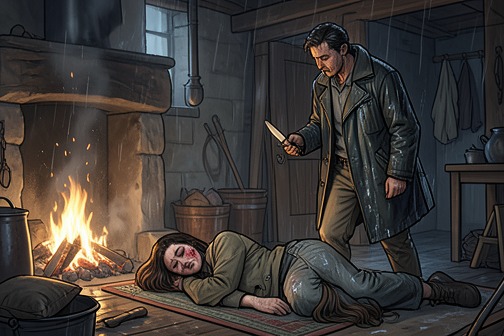
[Todd Rescues Viola from Aaron's Camp](entity:event-recall-event-todd-aaron-viola-84ef127e1e1f) turns a search into a precarious escape: [Todd Hewitt](entity:character-recall-character-todd-hewitt-137d446caea3) finds [Viola](entity:character-recall-character-viola-01912bd40399) alive but drugged, and getting her to the [Small boat on the river](entity:object-recall-object-c46e6dcec539) requires both her help and [Manchee](entity:character-recall-character-manchee-553c4e158d6f)’s intervention. The rescue does not end with their reunion. Aaron catches up as Todd is too weak to board, and the final reversal comes when Manchee makes Aaron release Todd, allowing Viola to pull him into the boat.
## Finding Viola
Todd reaches the campsite and sees that Aaron is gone. The moment is initially organized around recognition: he has found Viola, and she is alive. That discovery does not make her safe or immediately able to leave. Her eyes are sleepy, her speech slurs, and bruising beneath them sharpens Todd’s response into anger. When she explains that Aaron drugged her, her condition gives the rescue a clear urgency: Todd has to get her moving while she is still drowsy and Aaron may return.
The scene makes Todd’s own physical state part of the danger. He whispers to Viola, shakes her shoulders and face to rouse her, and is already coughing and weakening. When she notices that he does not look well, the rescue briefly turns from a one-way effort to save her into a recognition that both of them are in trouble. Their reunion supplies no pause in which either can recover; Viola closes her eyes after identifying what Aaron has done, while Todd continues trying to get her up.
## A rescue becomes an escape
Viola recognizes that Todd came for her, and her face crumples slightly. The exchange registers the emotional consequence of his arrival without removing the immediate danger. Then Manchee bursts out of the bushes, barking Todd’s name and warning that Aaron is coming. The warning changes the rescue’s tempo: there is no longer time simply to rouse Viola or steady Todd before deciding what to do next.
Viola gets to her feet with a push that nearly knocks Todd over. When he begins to fall, she catches him; the two steady themselves against each other. Todd manages to point toward the boat. This reversal matters to the action: although he came to retrieve Viola, she is already supporting him as they try to leave. The rescue depends on a fragile partnership in which neither person can simply act as the other’s rescuer from a position of strength.
## The struggle at the boat
The boat is moving away as Todd tries to board, and he has no strength to get in. He falls into the water while it pulls ahead. Viola grabs his shirt and yanks him upward until his head and shoulders are over the front. Her intervention keeps him from being left behind, but does not yet get him safely aboard; Aaron is still close enough to roar at them, and Todd remains physically exposed between the water and the departing boat.
Manchee then leaps past Viola and launches himself at Aaron. Todd feels the dog’s feet strike his back and leave it as Manchee attacks with a snarl and howl, still calling Todd’s name. Aaron lets go of Todd’s feet. The sequence makes Manchee’s intervention decisive without making it a completed victory over Aaron: the dog’s leap interrupts Aaron’s grip, creating the instant Viola needs to keep hold of Todd.
## The narrow escape
Viola lurches backward but does not let go. Todd tumbles into the boat on top of her, and the movement carries them farther out into [The river](entity:location-recall-location-the-river-e5943904b871) as the boat pulls away. The immediate outcome is therefore a physical separation from the shore, not a narrated assurance that the danger has ended. The rescue succeeds at its crucial threshold—Todd is no longer falling into the water, and Viola is no longer alone—but Aaron’s approach has made that success dependent on a chain of hurried acts.
The scene distributes agency among all three companions. Todd finds Viola and points toward the boat; Viola rises, catches him, and hauls him aboard; Manchee’s attack makes Aaron release his hold. Each action answers a failure or limitation in the one before it. The reunion begins with Todd locating a drugged and weakened Viola, but its decisive image is not a solitary rescuer carrying her away: it is Viola refusing to release Todd while Manchee intervenes and the two of them tumble together into the moving boat.
Event 20
Manchee's Death
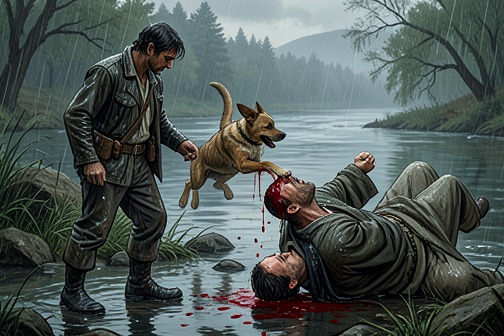
[Manchee](entity:character-recall-character-manchee-553c4e158d6f)’s death turns his loyal intervention into a terrible choice: he breaks Aaron’s hold on Todd, but Todd and [Viola](entity:character-recall-character-viola-01912bd40399)’s escape downriver leaves Manchee within Aaron’s reach. The scene makes the dog’s rescue of Todd inseparable from the loss Todd cannot prevent.
## The Intervention at the River
The struggle has become a tug of war between Aaron and Viola, with Aaron gaining the advantage. Then Todd hears a ferocious bark and sees Manchee leap past Viola, his feet striking Todd’s back as he launches himself at Aaron. The dog’s sudden attack breaks Aaron’s grip on Todd, allowing Viola to pull Todd into the boat as it begins to drift away.
At the river’s edge, Aaron falls into the soft sand, his robe tangled around his legs. Manchee attacks his face, biting on either side of Aaron’s nose and twisting his head until he tears the nose away. Aaron cries out, and blood sprays across the scene. The attack briefly reverses the danger: the pursuing man is hurt and on the ground, while Todd and Viola are already moving away in the boat.
Aaron responds by grabbing Manchee by the scruff and lifting him off the ground. Viola, weakened by drugs, rows furiously but cannot keep the boat from moving farther into the river. Aaron calls to Todd that he must choose between the girl and the dog. Todd reaches for his knife, but dizziness leaves him unable to act; he falls against the boat seat as Viola continues rowing against the current.
## The Choice and Manchee’s Death
Todd cannot take the choice Aaron offers him. As the boat drifts farther away, he reaches for his knife but is too dizzy to use it; instead, he puts a hand on Viola’s arm to stop her rowing. The current carries them away from the bank and Manchee. Todd cries an apology after the dog, while Manchee, confused and frightened, calls to him as he watches the boat leave. Their separation is not a deliberate abandonment: Todd is incapacitated, and the river makes the distance irreversible.
With the boat moving beyond reach, Aaron wrenches his arms. A crack, a scream, and Manchee’s cut-off yelp mark the killing. The abruptness of the sound gives the loss its force: the dog who had just broken Aaron’s hold on Todd is now beyond Todd’s help. Todd’s response is a wordless wail, his hands on his head, as grief overwhelms him.
The scene ends not with a recovery or explanation but with Todd knowing nothing more as the river carries the boat away. Water sounds, followed by bird noise, replace the cries and leave the death behind the escaping pair. Manchee’s intervention has enabled Todd and Viola to get away, but its cost is the companion Todd cannot save; the rescue and the loss remain bound together.
## Sound, Distance, and the Limits of Action
The scene’s knowledge is confined to Todd’s failing senses. The boat pitches and turns while he struggles to balance; his head spins, and Aaron’s [Noise](entity:state-recall-state-noise-4da2ff4fcf18) surges in red and black as the current takes the boat from the bank. The crisis is therefore registered not as a clear view of events but as a narrowing sequence of bodily shocks, shouted names, and sounds whose meaning Todd can scarcely bear to follow. [The river](entity:location-recall-location-the-river-e5943904b871)’s motion continues regardless of what he can decide or perceive.
That restricted perspective shapes the ending. Manchee’s calls reach Todd across the widening distance, but they cannot become a path back to him; Todd’s awareness collapses before the boat is carried away. The final shift from the cries at the riverbank to water and bird noise leaves the killing outside the escapees’ reach and outside Todd’s consciousness. The scene’s broken sensory sequence makes separation more than physical: the boat carries Todd and Viola onward, while the last sounds of Manchee’s life remain behind them.
## A Rescue Without a Victory
Manchee’s death overturns the expected shape of a rescue: the intervention succeeds in freeing Todd from Aaron’s grip, yet it cannot secure safety for the rescuer. The escape therefore has no clean victor. Aaron’s demand that Todd choose turns loyalty into a weapon, but the outcome is determined less by a freely made decision than by the boat and current carrying Todd and Viola beyond reach. Manchee’s action saves Todd at the very moment it exposes him to fatal danger; the scene binds courage to loss without making that loss a deliberate sacrifice or a triumph.
Event 21
Todd Reunites with Ben
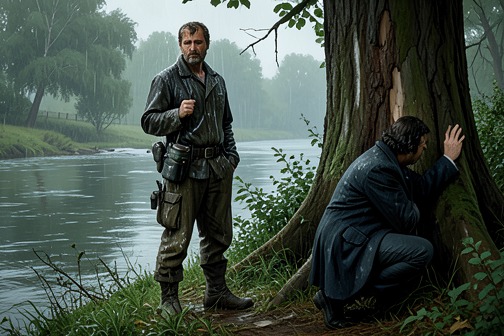
[Todd Reunites with Ben](entity:event-recall-event-todd-ben-7312ad51386a) is the moment [Todd Hewitt](entity:character-recall-character-todd-hewitt-137d446caea3) finds the adoptive father he had feared lost. Recognition across the river brings an immediate, physical reunion, but it does not restore the life Todd has left behind: [Ben](entity:character-recall-character-ben-964df7d0a5ee) confirms the weight of his losses, then reveals that an army is after him and directs him toward [Haven](entity:location-recall-location-haven-cdfff42acfaa). The scene moves from expectation, to relief, to grief, and finally to renewed danger.
## The song across the river
Todd first recognizes Ben through a song. He hears someone singing, and the words of the familiar song bring Ben to mind; as Todd says Ben’s name, his [Noise](entity:state-recall-state-noise-4da2ff4fcf18) grows louder. The recognition is not yet certainty. He tries to listen beneath the river, the birds, and his own Noise, attending to what is distant and partly obscured before [Viola](entity:character-recall-character-viola-01912bd40399) identifies the other side of the river as the direction to go.
Viola runs across the bridge, and Todd follows, passing her as he searches and listens. The crossing gives the recognition a physical course: the song has drawn him toward the far bank, but he must still find its singer among the leafy shrubs. There, Ben is crouched behind greenery, one hand against a tree trunk, watching Todd approach. The concealment and watchfulness make the encounter a discovery rather than a planned arrival; Ben sees Todd coming before Todd reaches him.
## Recognition and embrace
The decisive recognition comes when Todd sees that the man in the shrubs is Ben. Ben’s face relaxes, and his Noise opens as he spreads his arms. Todd leaps from the bridge into the bushes and nearly knocks Ben over. The reunion is expressed first through action and shared Noise, not through an explanation of how they came to meet. Todd’s relief is immediate enough that he imagines everything will be all right, a hope the scene will soon qualify.
Ben grips Todd tightly and calls him by name while Viola stays back, allowing the two to greet each other. Todd hugs Ben repeatedly. When he draws away, he grabs the front of Ben’s shirt and shakes him, unable to settle on what to do with his hands; the gesture conveys affection that Todd cannot readily put into words. Ben laughs at the force of the embrace and says it is good to see him. Todd answers by repeating Ben’s name, while Ben nods and smiles. Their reunion is mutual, but its emotional force is especially visible in Todd’s repeated attempts to hold on to the fact that Ben is there.
## Grief within the reunion
Relief gives way to grief as Todd confronts a loss he had suspected but not known for certain. Ben’s slow, sad nod confirms what Todd feared. Todd is also struck by Ben’s appearance: he is dirty, with blood clotted on his nose, and seems as though he has not eaten for a week. These signs show hardship without changing Todd’s recognition of him; despite them, he is still Ben, the person who can read Todd as no one else can.
Ben’s Noise asks about [Manchee](entity:character-recall-character-manchee-553c4e158d6f), and Todd shows him what happened. Todd’s eyes fill, and Ben takes him into his arms again. Todd then cries over Manchee, [Cillian](entity:character-recall-character-cillian-746514cf96d5), and the life that has ended. He repeats that he left Manchee. Ben says he knows, and Todd hears the same words in Ben’s Noise. Their understanding is conveyed through both spoken reassurance and the thoughts Todd perceives: Ben does not answer by disputing Todd’s guilt or minimizing the loss. The embrace becomes a place where Todd can acknowledge grief that the excitement of finding Ben had briefly displaced.
## From refuge to warning
The reunion does not leave Ben free to focus only on Todd. He asks Viola to keep watch and to alert them if she sees anything from either the settlement or the road. Viola agrees and steps away from the greenery, giving Ben and Todd a moment together while remaining responsible for watching their surroundings. Her presence also makes the meeting more than a private homecoming: Todd has arrived with a companion, and the danger around them requires attention even as they reconnect.
Ben then tells Todd that events have escalated and that he must reach Haven as fast as possible. Todd already knows he needs to get there, but asks why Ben is pressing the instruction; Ben answers that an army is after him. This new information sharply changes the meaning of the reunion. Ben is not simply a familiar figure found at the end of a search: he is also the bearer of urgent knowledge about the pursuit, and the meeting immediately becomes part of Todd’s effort to reach safety.
## Significance
The scene’s emotional turn rests on the contrast between what Todd hopes upon finding Ben and what Ben must tell him. The song, the crossing, and the embrace briefly make recovery seem possible; Ben’s confirmation of loss returns Todd to grief, and the warning about the army restores the immediate pressure of flight. These changes do not cancel one another. Todd can be overjoyed to find Ben, mourn Manchee and Cillian in his arms, and still have to move toward Haven without delay.
The reunion also shows how the characters communicate beyond direct speech. Ben’s Noise opens as he welcomes Todd, asks about Manchee through Noise, and shares Todd’s acknowledgment that he left the dog. Todd’s understanding of Ben’s thoughts makes their recognition reciprocal: Ben reads Todd, and Todd hears Ben’s response as sincere. The scene therefore joins affection, grief, and practical warning in one encounter. Its comfort is real, but it cannot return Todd to the life he has lost or remove the danger following him.
Event 22
Armed Standoff and Escape at Carbonel Downs
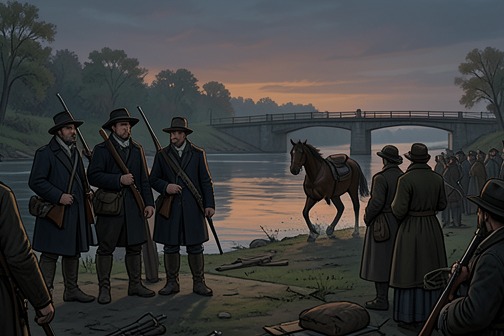
The [Armed Standoff and Escape at Carbonel Downs](entity:event-recall-event-carbonel-downs-b26df43d77d3) turns an encounter over truth into a test of trust, law, and immediate survival. As [Doctor Snow](entity:character-recall-character-doctor-snow-0553c58bef71) and an armed group confront [Todd Hewitt](entity:character-recall-character-todd-hewitt-137d446caea3), [Viola](entity:character-recall-character-viola-01912bd40399), and [Ben](entity:character-recall-character-ben-964df7d0a5ee), the town’s suspicions threaten to separate them and expose them to arrest. The sound of an approaching army changes the calculation: Doctor Snow releases the three, and they escape toward [Haven](entity:location-recall-location-haven-cdfff42acfaa). In the aftermath, Ben’s disclosures begin to overturn the history Todd thought he knew.
## The approach and the accusation
The confrontation begins when Doctor Snow calls across the river to Todd. The music associated with [Carbonel Downs](entity:location-recall-location-carbonel-downs-f2c992d4ded0) is competing with the [Noise](entity:state-recall-state-noise-4da2ff4fcf18) of men crossing the bridge; Todd recognizes that the music can conceal an approaching group. Doctor Snow comes with [Jacob Snow](entity:character-recall-character-jacob-snow-46a5a991872f) and a number of men whose rifles make clear that this is more than a conversation. They see Ben with Todd and Viola, and their suspicions harden as they interpret the scene.
Viola does not answer when Doctor Snow asks whether she has told the men about the approaching army. Other members of the group dismiss her account and identify Todd as a man of [Prentisstown](entity:location-recall-location-prentisstown-5c48443019b4). They fear that he is leading the army to them. Todd faces the choice of how much truth to tell, while Ben raises his hands and insists that Todd is innocent and that he is the one the men want.
The accusation becomes an armed standoff. A rifle is raised toward Ben, and another man argues that the group could be sitting ducks if Todd and Viola have disclosed their preparations to the army. Doctor Snow counters that Todd had been sick and unconscious, but the explanation does not satisfy the armed men. His authority as head of the council of eldermen is challenged, and a second rifle is raised. The disagreement is not simply over what happened; it is over whether fear should be allowed to decide guilt before an approaching force reaches the town.
## Law, resistance, and the decision to release them
Doctor Snow orders that Todd and Viola be taken back into town, assigning Viola to the women and Todd to fight alongside the men. He nevertheless says that Ben must answer to the law, even while acknowledging his belief that Ben is looking for his son. The eldermen’s reluctant agreement gives the ruling the appearance of collective authority, but the order would separate the group at the moment they are trying to escape the army.
Todd resists being taken. When a man grabs him, Todd uses his knife to make the man release his arm and tells Ben to run. Viola also fights the person holding her, biting his hand and freeing herself. The armed men respond by readying their rifles; a threatened blow from the injured man raises the danger further. Doctor Snow shouts for the group to stop. In the sudden quiet, the sound of horses approaching from the road makes the immediate threat unmistakable.
Doctor Snow weighs the time remaining before the riders arrive against the trouble that detaining Todd, Viola, and Ben would cause. He decides to let them go. One of the men continues to call Ben a traitor and murderer, but Doctor Snow insists that the town has to be protected and invokes the safety of his son and the other man’s son. He warns the fugitives that they may have sealed Carbonel Downs’s fate, while Todd maintains that they have not. Doctor Snow does not claim certainty: he says he would like to believe Todd, then turns the armed men toward their posts as the horses draw nearer.
## Escape under pressure
Todd, Viola, and Ben avoid the river road and run through the trees toward Haven. Within ten minutes, gunshots sound behind them. They do not turn back; the shots fade as they continue running. Todd and Viola are faster than Ben, so at times they slow down to let him catch up. The escape therefore carries both the urgency of pursuit and the practical need to keep the group together.
The scene’s reversal is abrupt but incomplete. The men at Carbonel Downs have not resolved their suspicions, and the approaching army remains a danger to the town; Doctor Snow’s choice buys the fugitives a chance to continue, not safety for anyone left behind. The gunshots mark the point at which the dispute gives way to consequences beyond the bridge. Todd’s insistence that they are running from the army is set against the fact that Carbonel Downs must now prepare to meet it without knowing how much the newcomers have revealed.
## Ben’s account changes the meaning of the past
As the three continue toward Haven, Ben begins to answer Todd’s questions about the truth. He explains that the [Noise germ](entity:concept-recall-concept-noise-germ-0b0f8cbc89b9) was not a weapon used by the [Spackle](entity:character-recall-character-spackle-11fadbeae3d5): it was already present in the air when humans landed on the [New World](entity:location-recall-location-new-world-7c8068dcbb7d). Within a day, people could hear one another’s thoughts. The planet’s living things were connected through a constant flow of information, while humans were not equipped to bear it; too much information became Noise. This account overturns the suspicion that the germ originated as an act of war.
Ben also describes the hardship that spread across the New World: failing crops, sickness, and a lack of prosperity. As conditions worsened, a poisonous preaching began to blame the Spackle. Todd recognizes the shame attached to that history as Ben explains that, after the Spackle were killed, men in Prentisstown killed the women of the settlement and the men who tried to protect them. Ben distinguishes those responsible from all men, but identifies [Mayor Prentiss](entity:character-recall-character-mayor-prentiss-626bb6394987) and Aaron as figures whose preaching helped sway many toward the killings.
The story of [Jessica Elizabeth](entity:character-recall-character-jessica-elizabeth-3f4ccaa33110) makes the destruction of New Elizabeth more specific. She was its mayor and saw the danger coming. She organized some girls and younger boys to flee across the swamp, but Mayor Prentiss’s men attacked before she could leave with the women and the men who had not joined the violence. Todd understands that New Elizabeth became Prentisstown. His mother, who had hoped in other people’s goodness, eventually gave him to Ben and [Cillian](entity:character-recall-character-cillian-746514cf96d5) to keep him safe when he was too young to be sent away.
## A wider history of coercion
Todd’s later understanding of the town’s laws deepens the meaning of Ben’s accusation and the armed men’s insistence that the law must be followed. Men who seemed to have disappeared from Prentisstown had in fact been killed under its coming-of-age rule. Mr Royal, Todd’s former schoolteacher, did not shoot himself: Seb Mundy was made to kill him on his own thirteenth birthday while the men of Prentisstown watched. Mr Gault, who had tried to escape through the swamp, was executed under the same system on [Mr Prentiss Jr](entity:character-recall-character-mr-prentiss-jr-d2c05f47a7e1)’s thirteenth birthday. These revelations expose a community in which disappearance, law, and public ritual conceal violence rather than explain it.
Against that history, the Carbonel Downs standoff places Todd between competing claims of innocence, law, and protection. Doctor Snow’s first ruling would have confined Todd and Viola and subjected Ben to the law; the arrival of the army forces him to choose the town’s defense over detention. His decision does not erase the danger or settle whether Todd’s account is true. It does, however, allow the three to remain together and continue toward Haven, while the disclosures made during their flight replace inherited blame with a more painful account of what happened.
Event 23
Ben Stays Behind to Stop Davy Prentiss
[Ben](entity:character-recall-character-ben-964df7d0a5ee)’s decision to stay and face [Davy Prentiss](entity:character-recall-character-davy-prentiss-5b25bec21727) turns an approaching pursuit into a painful parting: rather than let [Todd Hewitt](entity:character-recall-character-todd-hewitt-137d446caea3) and [Viola](entity:character-recall-character-viola-01912bd40399) risk being caught beside him, Ben remains behind to buy them time. The scene joins a practical act of protection to a personal reckoning. Ben calls his choice atonement, while Todd experiences it as another loss; the two leave the hillside in opposite directions, with no account here of what happens when Ben meets Davy.
## The Pursuer Returns
The separation begins with a sound before the rider is visible. A relentless hoofbeat approaches along the road, and Viola’s immediate frustration conveys how familiar the danger of pursuit has become. Ben listens and initially judges that there is only one horse. Todd searches farther down the road with binoculars; what he sees confirms the threat: [Mr Prentiss Jr](entity:character-recall-character-mr-prentiss-jr-d2c05f47a7e1) is alive, untied, and back on his horse. The discovery is striking because the rider’s return overturns any expectation that he has been securely restrained. The scene identifies him as Davy Prentiss through the others’ recognition, making the approaching figure both a specific pursuer and the continuation of the danger that has driven the group onward.
The binoculars briefly pass from Todd to Viola and then to Ben. Ben remarks on the instrument, but the scene’s decisive change is not what it lets him see: Todd notices in Ben’s [Noise](entity:state-recall-state-noise-4da2ff4fcf18) that a decision is forming. This is how the separation arrives before it is spoken. Todd starts to object, and Ben cuts him off with a direct refusal. His statement that this is where he leaves them makes the choice immediate; his confidence that he can handle Davy does not turn it into a shared plan. Ben has already decided to make himself the obstacle between the horseman and the two who are leaving.
## Ben’s Choice and Its Cost
Todd refuses to accept the separation and raises his voice. Ben looks him in the eye, and Todd notices that Ben no longer seems to need to bend down to meet his gaze. The small physical observation accompanies a larger shift in their relationship: Ben speaks to Todd as someone who can be addressed as an equal, even as he takes responsibility for deciding what must happen next. He explains his choice as atonement for the wrong he has done, accomplished by keeping Todd safe. The explanation gives the stand a moral history without specifying the wrong again; what matters in this moment is Ben’s understanding that protection is the action through which he can answer for it.
Ben also says he cannot come to [Haven](entity:location-recall-location-haven-cdfff42acfaa) because he is the enemy. His words make the obstacle more than distance or the approaching rider: Ben believes that his place in the conflict prevents him from sharing the destination toward which Todd and Viola are heading. Todd answers from the vulnerability of their bond, asking Ben not to leave him again. The exchange sets Ben’s protective purpose against the hurt his choice causes. He is trying to keep Todd safe, but the means of doing so is another separation that Todd cannot make feel fair.
## A Farewell and a Measure of Adulthood
Todd says he is not yet a man and does not know how many days remain before he becomes one. Ben answers with a precise number: sixteen days until Todd’s birthday. He then rejects the idea that adulthood is simply a date still to come, telling Todd that he has been a man for a good while already. The reassurance matters here because it arrives at the moment Todd is losing Ben’s immediate protection. Ben cannot promise to stay beside him; instead, he affirms Todd’s capacity to go on without him.
Ben lifts Todd’s chin, embraces him, and tells him that no father could be prouder. The gesture and words clarify the familial force of their attachment without changing the practical decision. Ben hands the binoculars to Viola behind Todd’s back, a quiet transfer of a useful object as he prepares to leave. Todd protests that the parting is unfair, and Ben agrees rather than trying to comfort him with a denial. His answer preserves the pain of what is happening, while he leaves Todd with the thought that there is hope at the end of the road.
## The Parting and Its Immediate Consequence
As the hoofbeats grow closer, Ben tells Viola that he will stop Davy and buy the others time. He asks her to take care of Todd and waits for her word; Viola promises. The request establishes a practical trust between them at the instant Ben hands responsibility onward. Todd pleads once more, but Ben grips his shoulders for a final time and repeats the message of hope. He then runs downhill from the cemetery toward the road. At the bottom, he looks back and sees that Todd and Viola are still watching. His shout sends them into motion: they must run.
Todd and Viola flee down the other side of the hill, away from Ben. The separation is therefore enacted in the scene’s physical geography: Ben descends toward the road and the returning rider, while they escape in the opposite direction. Todd does not describe what he feels, and the narration stresses that he cannot imagine a life after this parting. Yet he runs when Viola calls him, and the two reach the river again, with the road on their other side. The repeated return to river and road makes escape feel like another turn in a continuing pursuit, not a settled arrival. The scene ends with Todd and Viola moving onward, while Ben’s confrontation and fate remain unresolved here.
## Narrative Significance
The event changes the group’s immediate arrangement and gives Ben’s protection a final, costly form: he does not accompany Todd to Haven, but takes the pursuing rider’s attention upon himself so the others can continue. For Todd, this is at once abandonment and care. The scene does not erase the hurt by calling the decision necessary; Ben acknowledges the unfairness, and Todd’s refusal to accept the parting remains audible in his protests and silent grief.
Ben’s farewell also redirects the meaning of Todd’s approaching birthday. The sixteen-day countdown belongs to a coming-of-age rule, but Ben’s judgment places Todd’s character ahead of that formal threshold. In the same exchange, fatherly pride, atonement, and hope become things Ben can give even while leaving. The event closes not with a narrated victory over Davy, but with two linked actions: Ben turns toward the danger, and Todd runs on because Ben tells him to. That unresolved division preserves both the sacrifice’s immediate purpose and the uncertainty surrounding its cost.
Event 24
Todd and Aaron Face Off in the Waterfall Church
[Todd Hewitt](entity:character-recall-character-todd-hewitt-137d446caea3) and Aaron Face Off in the Waterfall Church is the confrontation in which Todd uncovers the purpose behind Aaron’s pursuit and the truth behind [Prentisstown’s coming-of-age rite](entity:concept-recall-concept-af231fb9cee4). As [Viola](entity:character-recall-character-viola-01912bd40399) is endangered and Aaron closes in, Todd leads him into the [Church Behind the Waterfall](entity:object-recall-object-f4baac5e95c8) and names the intended sacrifice: Aaron himself. The revelation links the immediate standoff to the town’s concealed history of killings, while the scene ends with Todd and Aaron alone, facing one another across a knife and a pulpit.
## Background and the town’s buried violence
The confrontation rests on what Todd has learned about the history of the [New World](entity:location-recall-location-new-world-7c8068dcbb7d). As [Ben](entity:character-recall-character-ben-964df7d0a5ee) explains, hardship spread across the settlements: crops failed, sickness persisted, prosperity did not come, and the hoped-for Eden never arrived. Blame took hold, first as preaching and then as a movement directed against the [Spackle](entity:character-recall-character-spackle-11fadbeae3d5). The resulting war was radically unequal: humans had guns, the Spackle did not, and the conflict devastated them. Some survived, but learned not to approach humans closely.
Todd also knows that violence did not stop with the war. He states that after the Spackle were killed, men in [Prentisstown](entity:location-recall-location-prentisstown-5c48443019b4) killed the women there. Ben confirms that many men took part, influenced by [Mayor Prentiss](entity:character-recall-character-mayor-prentiss-626bb6394987) and by Aaron’s preaching that what was hidden must be evil. The killings also targeted men who tried to protect the women. Todd’s mother was among those killed. This history makes the church confrontation more than a private dispute: the town’s violence has been justified through collective fear, religious language, and the silencing of those who might resist.
The coming-of-age custom gives that violence a continuing form. Todd recognizes that boys become men in Prentisstown by killing another man, alone, while the other men are complicit. Men thought to have disappeared had in fact been selected as victims. Mr Royal, Todd’s former schoolteacher, was killed by Seb Mundy on Seb’s thirteenth birthday; Mr Gault, who had tried to escape, was executed after Mayor Prentiss arranged for [Mr Prentiss Jr](entity:character-recall-character-mr-prentiss-jr-d2c05f47a7e1) to torture him on his own thirteenth birthday. If no escapee was available, the authorities could choose someone disliked in Prentisstown and claim he had disappeared. Each boy’s passage into manhood was thus built on another person’s death and on the town’s shared concealment of the truth.
## From the river to the hidden church
The immediate approach begins with a boat coming down the river, close enough for its occupants to be seen without binoculars. Its rifle and robe identify the danger before the encounter is resolved. Near the road by the Falls, a voice calls Todd by name, and the speaker reaches for his rifle. A shot follows, and Viola falls over the edge of the road. Todd’s later search turns on a faint trail leading away from the road toward the waterfall cliff; he follows it to a steep drop and a place almost below the Falls.
Todd and Viola make their way along the wet cliff ledge, holding to roots for balance. The route changes where the ledge drops and widens into more distinct carved steps, nearly a stairway. Its construction suggests that someone has been there before. They descend beside the falling water, and the tunnel opens into a cavern enclosed by the waterfall. Inside, they find four rows of simple stone pews, a central aisle, and a raised rock pulpit. A carved circle with two smaller circles beside it represents the New World and its moons. The place is a church hidden beneath the waterfall, its arrangement turning the setting into a stage for Aaron’s religious performance.
## Todd names the sacrifice
The danger follows them into the cavern: Aaron has found the tunnel. Todd grips his knife and sees fear in Viola’s face, but he stands and says he knows what Aaron wants. He then calls Aaron by name, loudly enough to draw him down the steps. The choice to summon the pursuer brings the threat into the open rather than allowing it to dictate the encounter from beyond the church.
When Aaron enters, Todd tells him that neither Viola nor Todd is the sacrifice. He identifies Aaron as the intended victim and opens his [Noise](entity:state-recall-state-noise-4da2ff4fcf18) so that Aaron and Viola can see that he means what he says. Todd connects this conclusion to Ben’s explanation of how boys in Prentisstown become men: they kill another man on their own. The apparent disappearances, the birthday killings, and the town’s complicity form one system. Todd understands that his own approaching adulthood was supposed to make him part of it, but that he was the last boy left to undergo the rite.
Aaron’s response does not erase the danger, but it gives Todd’s deduction weight. Aaron calls Todd the final soldier in God’s perfect army and asks whether he is a messenger or a deceiver. He places his rifle on the pulpit. For a moment, the exchange takes on the shape of a sermon: Aaron stands at the church’s pulpit, reaches his Noise toward Todd, and invokes sacrifice, God’s work, and martyrdom. Yet the pulpit also anchors Todd’s accusation in the very institution Aaron uses to give violence sacred meaning.
## The standoff’s unresolved ending
Aaron’s surrender of the rifle does not end the confrontation. He looks toward Viola and dismisses the possibility that she might try to take advantage; moments later, the rifle is gone, leaving Todd and Aaron together with the knife. Aaron assumes the posture of a preacher at his pulpit, holding his arms open and lifting his eyes toward the shining roof of water. The scene closes before their physical conflict is resolved, with Todd’s recognition having changed what the confrontation means but not removed its danger.
The decisive turn is from confusion about Aaron’s intended victim to Todd’s understanding of the rite that has shaped Prentisstown. The revelation exposes a community in which hardship and fear have been redirected toward the Spackle, women, escapees, and other designated victims, while each new generation is taught to inherit violence as adulthood. Against that pattern, Todd’s insistence that Aaron is the sacrifice marks a refusal to accept the town’s account of what manhood requires. The church gathers the conflict’s opposing meanings into one place: Aaron’s ritualized claims to divine purpose and Todd’s effort to make the hidden crime visible.
Event 25
Aaron's Death
Aaron’s death ends his pursuit of Todd and [Viola](entity:character-recall-character-viola-01912bd40399), but it does not come as a simple victory over a single persecutor. The confrontation follows revelations about the violence that shaped [Prentisstown](entity:location-recall-location-prentisstown-5c48443019b4) and culminates in a reversal: Todd faces Aaron, yet Viola makes the fatal choice. Aaron falls over the edge beneath the waterfall, and the [Noise](entity:state-recall-state-noise-4da2ff4fcf18) associated with him stops.
## Causes and Background
The confrontation comes after Todd has learned how violence in the [New World](entity:location-recall-location-new-world-7c8068dcbb7d) became organized and justified. [Ben](entity:character-recall-character-ben-964df7d0a5ee) explains that hardship had spread across the settlements, with failing crops, sickness, and little prosperity. As conditions worsened, preaching blamed the [Spackle](entity:character-recall-character-spackle-11fadbeae3d5); that prejudice grew into a movement and then into war. The imbalance of weapons made the result devastating for the Spackle, though Ben acknowledges that not all of them were killed. He also says the survivors learned to avoid men.
The violence did not end with that war. Todd tells Viola that men in Prentisstown killed the women there, and Ben confirms that many men were swayed by [Mayor Prentiss](entity:character-recall-character-mayor-prentiss-626bb6394987) and Aaron’s preaching. Aaron had taught that whatever was hidden must be evil; men killed the women and those who tried to protect them. The disclosure makes Aaron’s role larger than that of a pursuer in the immediate scene: he is also associated with an ideology that converted fear and suspicion into collective violence.
Todd’s account of Prentisstown’s coming-of-age killings further exposes the community’s complicity. Men who had supposedly disappeared were in fact killed by boys on their thirteenth birthdays, as the rest of the men watched. Among the examples Todd recalls are a former schoolteacher made to shoot a man and another man tortured to death by [Mr Prentiss Jr](entity:character-recall-character-mr-prentiss-jr-d2c05f47a7e1). when the Mayor could not use a captured escapee. Todd recognizes the pattern as a system in which one man’s life was assigned to a boy so that the boy could become a man. He sees the town as collectively guilty, while marking himself as an exception. This history informs the moral pressure of his meeting with Aaron, whose language of purification echoes the violence Todd has just come to understand.
## The Confrontation
Before Todd can face Aaron, Viola strikes him with a rock, interrupting his advance. Todd lays Viola down gently, then stands to confront Aaron. Aaron urges him toward purification, framing the encounter in terms that invite Todd to treat violence as a way to become clean. Todd apologizes under his breath without knowing precisely to whom or for what, then charges Aaron with his shoulder. The movement is a direct answer to Aaron’s provocation, but it does not settle the encounter.
As Todd is carried toward the edge, he realizes that he will use the Noise. He calls Viola’s name, and she picks up the knife. Todd sees her move toward Aaron while he struggles to keep from going over the ledge. Aaron, trying to rise, directs his remaining attention toward Viola; his Noise conveys anger and fear. The scene shifts the decisive action away from Todd at the moment when Aaron’s invitation to violence has drawn him into the fight.
## Aaron’s Death
Viola advances and drives the knife into the side of Aaron’s neck. Todd cannot stop her. Aaron’s body slumps away from the pulpit, passes over the edge, and disappears beneath the wall of water, taking the knife with him. The narration presents the fall as the immediate, irreversible consequence of Viola’s action, rather than as a death Todd directly delivers.
The Noise associated with Aaron completely stops. Its cessation gives the death a consequence beyond the removal of an active pursuer: a presence that had accompanied the conflict is suddenly absent. Viola sits down beside Todd, the scene ending not with a declaration of triumph but with the two of them together after the violence. The knife is gone with Aaron, and the immediate danger he posed has ended.
## Consequences and Significance
The scene turns on a distinction between resisting Aaron and accepting his account of what resistance requires. Todd does attack him, and briefly appears to enter the violent choice Aaron has been urging. Yet Todd’s words to Viola and his inability to prevent her final action leave the outcome outside his control. Viola, previously threatened and pursued by Aaron, becomes the person who ends that pursuit. The event therefore changes their immediate balance of power while preserving the moral difference between Aaron’s call for purification through violence and the action that actually kills him.
Aaron’s fall also closes the immediate confrontation without erasing the history disclosed beforehand. The war against the Spackle, the murder of Prentisstown’s women, and the coming-of-age killings are not undone by his death. Instead, the revelations make his end part of a wider reckoning with how violence is preached, repeated, and shared. Todd’s recognition that the town’s men were complicit frames the death as an interruption in that system, not proof that its consequences have vanished.
Event 26
Viola Is Shot by Davy Prentiss
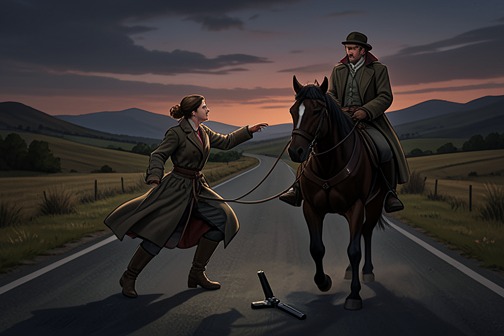
[Davy Prentiss](entity:character-recall-character-davy-prentiss-5b25bec21727)’s shooting of [Viola](entity:character-recall-character-viola-01912bd40399) abruptly turns a moment on the road into a fight over whether she can be saved. The attack arrives without warning: Viola is wounded, [Todd Hewitt](entity:character-recall-character-todd-hewitt-137d446caea3) has no knife, and Davy is still armed and mounted. Todd drives him away from her, but the scene’s decisive choice is not retaliation. When Davy is dragged off and his pistol falls, Todd abandons it and returns to Viola.
## The Violence Behind the Encounter
The shooting takes place against a history of violence that Todd has only recently begun to understand. [Ben](entity:character-recall-character-ben-964df7d0a5ee) explains that years of hardship on [New World](entity:location-recall-location-new-world-7c8068dcbb7d)—failed crops, sickness, and the loss of any hope of prosperity—gave way to preaching that blamed the [Spackle](entity:character-recall-character-spackle-11fadbeae3d5). That accusation hardened into a movement and then a war. Humans had guns and the Spackle did not; Ben describes the resulting defeat as devastating, though not total. The survivors learned to keep their distance from humans.
The history Todd learns does not establish a direct motive for Davy’s attack, but it gives the encounter a wider context: violence repeatedly grows out of systems that identify targets and make harm seem permissible. In [Prentisstown](entity:location-recall-location-prentisstown-5c48443019b4), Todd discovers that men killed the women, as well as men who tried to protect them, after [Mayor Prentiss](entity:character-recall-character-mayor-prentiss-626bb6394987) and Aaron helped spread the belief that what was hidden must be evil. Todd’s mother was among the dead. This account links intimate loss to a political and religious climate in which a group’s fear and blame become permission to attack others.
Todd also learns that the town’s coming-of-age custom made violence a public obligation. Boys were made to kill a man on their thirteenth birthdays, while other men watched. Some escapees were captured for these occasions; when no captive was available, a disliked townsman could be declared to have disappeared and used instead. Todd sees the practice as collective guilt, with himself outside its complicity. The revelation makes Davy’s armed attack part of a larger pattern of male violence, but the scene does not say that this history is Davy’s immediate reason for shooting Viola.
## The Shot on the Road
The attack happens in daylight as Todd and Viola are together on the road. A sudden sound and Viola’s gasp make them look down; she has been shot in the abdomen. She touches the blood and raises her fingers, then falls forward. Todd catches her, stumbling under her weight, and looks up to find Davy Prentiss on horseback with a pistol in his outstretched hand. Viola recognizes that she has been shot and turns to Todd for help.
Todd reads the circumstances as nearly inescapable. There is nowhere to run, and he has no knife. His thoughts race toward the possibility that they have reached the end of the road, while Viola begins breathing heavily against him and Davy rides closer. Davy’s presence turns a wound into an immediate threat: Todd must attend to Viola while the armed pursuer remains within reach. The moment’s reversal is stark. The two are together, but their safety is suddenly precarious, and the person Todd most needs to protect cannot flee unaided.
When Viola says the wound burns, Todd lowers her, drops their bag, and removes his shirt to press it against the wound. He tells her to hold it in place, then faces Davy. Davy orders Todd to stand, and Todd does. The action briefly suspends the fight: Todd has made a practical attempt to help Viola, but he now has to confront the man who shot her before he can return to her.
## Todd’s Intervention
Todd waits for an opening and strikes Davy across the face with his fist. In the struggle that follows, he hits the horse’s hindquarters. The horse bolts back up the road and hill with Davy’s foot caught, dragging him over the ground. Davy’s pistol falls into the dust. The reversal removes Davy from immediate control of the encounter, but it does not undo the injury or make Viola safe.
The dropped pistol offers Todd a chance to arm himself. He does not take it. Instead, he runs back down to Viola at the edge of the scrub, leaving the weapon behind. That choice gives the scene its clearest measure of his priorities: he does not use the interruption to pursue Davy or claim the gun, but returns to the person who needs him. When Viola fears she is dying, Todd denies that possibility and lifts her, supporting her shoulders and knees.
## Consequences and Significance
The shooting changes the immediate objective from escape to getting Viola help. Todd’s blow and the runaway horse interrupt Davy’s attack, yet the pistol remains behind and the outcome of the confrontation is not a resolution of the wider pursuit. The available account ends with Todd carrying Viola away from the roadside, leaving the weapon where it fell. The danger has shifted from an armed attacker directly confronting them to the urgent uncertainty of whether Viola will survive.
The scene also contrasts public, imposed violence with Todd’s personal response to it. The town’s ritual made a boy’s killing of a man a communal passage into adulthood, with witnesses sharing in the act. [Here](entity:expression-recall-expression-here-6ac9216c844b) Todd uses force to stop an attacker, then turns away from the available weapon and back toward the wounded person. The contrast does not erase the violence of his intervention; it makes its purpose legible through what he does next. After striking Davy, Todd’s decisive act is care: he leaves the pistol and carries Viola toward help.
Event 27
Prentiss Seizes Haven and Captures Todd and Viola
[Mayor Prentiss](entity:character-recall-character-mayor-prentiss-626bb6394987)’s seizure of [Haven](entity:location-recall-location-haven-cdfff42acfaa) overturns the hope that [Todd Hewitt](entity:character-recall-character-todd-hewitt-137d446caea3) and [Viola](entity:character-recall-character-viola-01912bd40399) have reached safety. The army Todd believes is still approaching has already secured the town through surrender terms; Mayor Prentiss appears in the square ahead of it, declares himself the planet’s newly appointed President, and takes control of both fugitives. The capture turns a flight toward refuge into the opening of their imprisonment under his rule.
## Causes and Background
Todd and Viola reach Haven expecting it to offer safety. In the square, Todd pleads for help, and the first sign of the reversal is a voice from beside the church, followed by a lone horse. Mayor Prentiss arrives composed and unhurried, in clean boots and riding gloves. His appearance is the opposite of the exhausting pursuit Todd had expected: the ruler seems to have reached Haven without the army Todd thought was still a day away.
Todd recognizes that the dust seen moving toward Haven the previous day belonged to the advancing force. When he asks how Mayor Prentiss could already be there, the Mayor explains that the rumor of an army can be as effective as the army itself. He says Haven’s surrender terms were favorable, and that one condition cleared the streets so he could welcome Todd in person. The account makes the takeover a combination of military pressure and negotiated submission: the army’s reputation has helped secure the town before its full arrival, while the empty streets provide the Mayor with control of the meeting.
## The Takeover in the Square
The Mayor says he had expected his son to bring Todd to him, but instead has come himself. As he speaks, Todd notices people watching from windows and doorways, and four more men on horseback riding around the church. The scene thus shifts from an apparently private encounter to a public display of authority. The Mayor is not alone, and the residents’ presence at the edges of the square suggests how thoroughly his arrival has changed the conditions under which Todd and Viola can act.
Mayor Prentiss presents the takeover as the founding of a new political order. Holding out his hand as if presenting the world, he announces himself as the newly appointed President of the planet and welcomes Todd to its new capital. He names that capital New [Prentisstown](entity:location-recall-location-prentisstown-5c48443019b4). The grand declaration does not offer Todd protection; it makes clear that the ruler who has pursued him now claims authority over the place where he sought refuge. Haven’s surrender and the Mayor’s self-proclaimed presidency converge in a single encounter, turning the town into the setting for his rule.
Viola has her eyes closed and whispers Todd’s name. Todd holds her tightly. His response is to stay with her as the Mayor’s men close in, not to accept the welcome or the political terms it conceals. The narration frames the moment through Todd’s sudden recognition that the pair have run into a trap. Their arrival at the supposed destination has not ended the pursuit: it has delivered them directly to the person pursuing them.
## Capture and Immediate Aftermath
The seizure is confirmed in the following scene, when Todd wakes restrained in a vast room. His first question is about Viola, rather than his own location. The Mayor points out that Todd’s words and [Noise](entity:state-recall-state-noise-4da2ff4fcf18) show the same concern. That observation turns the capture into more than a physical defeat: even while bound, Todd’s priorities are legible to the ruler who has taken control of him. His attention remains fixed on whether Viola is safe.
Todd remembers that Mayor Prentiss’s men took Viola from his arms in the square. He had resisted until a blow knocked him unconscious; when he comes round, his hands are tied behind him and his feet are bound to a wooden chair. The transition from the square to captivity is presented through his recovering memory, emphasizing how abruptly the pair’s attempted escape has been cut short. Todd does not know where Viola has been taken, and the Mayor’s question about what has been done with her remains unanswered in this passage.
Mr Collins, identified as a farmer who grew corn and cauliflower and tended the Mayor’s horses, stands over Todd armed with a pistol and a rifle. When Todd threatens the consequences of harming Viola, Mayor Prentiss stops Mr Collins from striking him again, remarking that Viola already seems sufficiently hurt. The intervention does not release Todd or resolve Viola’s whereabouts; it shows instead that the Mayor controls the men around him and can choose when their force is applied. The immediate outcome is separation, restraint, and uncertainty: Todd and Viola have been captured, while Todd’s effort to protect her continues under the captor’s supervision.
## Significance
The event reverses the meaning of Haven. For Todd, reaching it had represented a chance to protect Viola and escape the pursuit; the Mayor’s arrival reveals that the town has already been brought under his power. The rumor of an army, surrender terms, watching residents, and the Mayor’s mounted escorts establish control before the newly proclaimed capital is named. The language of welcome and political inauguration therefore sits against the reality of capture.
The scene also brings Todd’s relationship with Viola into sharp focus without separating it from the conflict. In the square, he holds her close; after waking, he asks where she is before asking where he himself has been taken. Mayor Prentiss notices this priority and reads it as revealing. His observation makes Todd’s attachment part of the contest between them: the captor can restrain Todd and comment on what his Noise exposes, but the passage shows that Todd’s first concern remains Viola. The event closes the journey to Haven not with safety, but with the two companions in the Mayor’s custody and the new capital presented as the center of his authority.